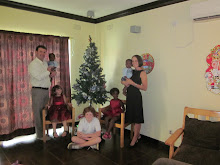
There are certainly challenges to life here in Malawi. The electricity always goes out just as we are about to leave for Date Night. Our bowels have all suffered. It is not uncommon for the entire city to suddenly be out of one of the main ingredients for that night's supper. However, there are also certainly many benefits to living here. I truly believe that the work we are doing helps improve the quality and length of life for our patients every day. My children have the opportunity to attend a school filled with people from all different cultures, where one of Eamonn's afternoon activities each week is to go to a nearby orphanage and play with babies who have lost their families. Plus, we get to go on safari on any random weekend.
We chose to leave for our first safari at 5 am this past Saturday, packing our sleeping children and near-incoherent nanny into our "new" truck, a weathered 10-seat white Pajero with benches that line the very back. The road out of town was populated with industrious people carrying buckets on their heads, burning garbage, and riding bikes. The air was cool, and the mist in front of us layered over the horizon so that it appeared as though we were driving toward the ocean. The sun rose slowly on our left, majestic and orange, burning through the
haze and illuminating the silhouetted hills that pushed through the thick fog. As we left the city we passed small villages of only a few mud and thatch houses, wells where women pumped
the day's water into bright colored plastic pails, and ox-drawn carriages filled with vegetables. Saturday is market day, and each of the villagers was bringing their goods to the nearest town, where hundreds of people gathered in groups along the roadside, selling neatly stacked piles of cabbages and tomatoes, onions, potatoes, even clothing. One local delicacy, which I finally stopped to photograph, is mice-on-a-stick. Apparently when the fields are burned in preparation for the next planting season all of the mice flee and are caught by young boys, who then skewer and (?) barbeque them to be sold, stacked on long sticks that they wave at passerbys on the main road.
We entered the Liwonde National Park about 3 hours after we left home, paid our entry fee (about $2 per person), and started the drive to the campsite and lodge. The road, while pitted, narrow and dusty, was not much worse then some parts of Lilongwe. The foliage was grey and sparse, and we passed over several completely dry riverbeds. We unrolled the windows
briefly to help spot animals, and were almost immediately accosted by large, biting (but
thankfully slow and stupid) flies that entered in droves. We began keeping count of how many each of us killed, but finally decided to roll up the windows and turn on the "a/c" when the body count reached double-digits. Eamonn kept track of the animals we spotted as we continued on, and by the time we arrived at the campsite an hour later we had seen many, including impala and baboons, although the big ones we'd been really looking for had still eluded us.
Mvuu lodge is a beautiful and rustic open-air pavilion made of hard wood and thatch, and beyond the main building the Shire river floats lazily by. We could hear the grunting of hippos in the distance as we set up our tent. The manager gave us a lengthy speech about the need to be alert, as we were truly camping in the bush, and informed us that if we were to encounter an elephant at any time, we should go back into our tents quietly and wait for it to leave. I could see my poor anxious Eamonn's pale face go a shade whiter as he spoke, and I had to spend several minutes after he left reassuring him that this was very safe and that no, no
one had died at this camp, or I would certainly have read about it in the Lonely Planet. The kids put on their bathing suits and we headed to the pool, which, it turned out, was teeming with life. So, instead of swimming, the children spent the next hour catching water bugs in plastic bottles from the water's edge. We went on another game drive before dinner, and lengthened the list of animals we'd spotted, including a herd of elephants standing in a thicket of trees eating quietly.
At one point during the drive I felt the urgent need for a bathroom, as my body had not yet completely recovered it's normal bowel function. We had come to a dead end in the road which appeared to culminate in a small village. I lay, sweating and in pain, in the front seat, while a girl of about 6 ran alongside the truck, her scabbed knees pumping beneath her tattered dress, with the joyful shout of "Aaazuuunguuu!!!" announcing our presence.
This, roughly translated from Chichewa, means "Whiiiiiite peeeeople!!!!", and we were soon overcome by a flashmob of barefoot children attempting English phrases and eagerly trying to peer into the car to see and touch the family. I stumbled, after a frantic attempt to communicate my needs to the children, to a small, three-sided brick structure with a plastic flap for privacy, enclosing a pit latrine in the dirt. Several feet below I noticed a gentle stream flowing, and held my nose in preparation for using the facilities. It was then that I noticed that the movement below me was not that of a flowing body of water, but a teeming mass of maggots. I will leave the rest of this portion of the adventure to the reader's imagination...
We returned to the camp, made dinner over our camping stove, and had just finished eating when we heard drumming from the other side of the grounds. When we investigated we found several men singing and dancing around a fire, telling stories of African village life through their music, as explained to us by the guides. Although it was captivating, the children were exhausted, so we headed back to the tent, holding hands and using my head lamp for light in the pitch-black night.
As we approached the tent and Dave went ahead to unzip it, I looked up to the left of our site, about 5 feet from our front door, and saw my light reflected in the unblinking eyes of an enormous (must've been 10 feet tall) elephant. He gazed at me blithely and continued chewing. I held tight to my kids' hands and said, in my best "I am an ED doctor and I am in total control " voice: "OK. Elephant. Everyone take a step back." Aine let out a brief shriek, Malawi began to whimper, and Eamonn burst into tears, but they all calmly stepped backwards, putting our beast of an automobile between us and the actual beast. We sought out a guard, who shined an enormous flashlight at the creature and banged on a tree with a large stick, and the elephant lumbered away. Needless to say, it took many minutes of negotiating to convince anyone to sleep in the tent that night. I myself did not sleep well, as I was still having belly issues, and was far too afraid to leave the tent to use the bathroom.
The next morning we went on a boat safari, and spent two hours cruising the riverside with a guide, spotting hippos, crocodiles, and herds of elephants, in numbers too high to count.
Later that day Eamonn apologized, clearly ashamed, for having been so afraid the night before. I explained to him the difference between being fearless and being courageous, and assured him that he had in fact shown great courage by spending the night camping in the bush, despite his fear. Adventures like the one we'd had teach us lessons in a way that we could not have learned them at home, I told him, and are one of the benefits of living in Africa. Plus, they make really great stories.
Thursday, September 1, 2011


Sunday, August 21, 2011
Worst. Date Night. EVER.
The story I am about to tell is humiliating and gross. It is only in the interest of literary truth-telling that I am sharing it.
The weekend started out well. The Lilongwe Wildlife Center had a showing of Harry Potter and the Deathly Hallows, Part 1 on Friday evening. We had a quick dinner of pizza and showed up at the center, which had a fabulous child-sized mountain to climb, replete with a knotted rope that the kids used to pull themselves up. They did so repeatedly, sliding down the dirt afterwards, so that they were completely orange with dust within minutes of arrival. There was a fabulous wooden playground, and a small thatched-roofed bar selling drinks and chips. The movie was being shown on a makeshift screen that consisted of a white sheet folded in the middle and held together with a clothes pin. There was a bowl of marshmallows for toasting (not too bad), and bags of cheetos which substituted for the popcorn that had been promised, as the machine had broken. In typical African fashion, the movie started an hour late, and suffered multiple technical problems before it went into full-swing, and the fold in the sheet tended to distort the character's faces to the point that they were occasionally unrecognizable, but overall it was really enjoyable.
Saturday was Date Night. I put it in capital letters because anyone who has been married for a long enough time recognizes the importance of that sacred night when adults shed their stained sweatpants, pry the sticky hands from around their legs, and briefly escape together in pursuit of that illusive and legendary holy grail of parenting: Adult Conversation. This night was going to be special. One of the Baylor doctors was having a party at her house (to celebrate "the revolution"), and I took the opportunity to dress up in my snazzy black leather boots and apply makeup. I even went so far as to pilfer a gorgeous African print skirt that belonged to my (much younger and hipper) nanny.
When we first arrived at Leah's house we were handed a glass of white wine and given a tour. Her husband Jared is a truly talented artist, who does murals of famous people, as well as family and friends, using stencils he has created from photographs. The work is amazing, and as I admired it their home filled with people and I had my second glass of wine. The partygoers were doctors, peace corps workers, Malawian nationals, and aspiring med students. The conversation was interesting, the wine was sweet, and I was out with my best friend. I was having a great time.
Suddenly, I felt a rumbling in my belly. It was not a pain, but it was enough to make me put down my glass of wine. Within 5 minutes I had begun to sweat, and felt a cold chill sweep over my body from my scalp to my fingertips. A searing pain began in my back, between my shoulder blades, and my heart began to feel as though it was exploding in my chest. The world around me became gray and distant, and I held on to furniture as I made my way to Dave, interrupting his conversation to say that I had to go home. Now. I must have looked something like I felt, because he immediately stopped his conversation, gathered our belongings, and sheperded me toward the door. I muttered my apologies to Leah through thick lips, stumbled to the car, and dragged myself into the front seat.
I have given birth twice. I know what pain is. The pain I was in last night was as profound and intense as labor, but without the blessed relief that comes between contractions. My abdomen convulsed, my chest burned, and I felt consciousness attempting to flee as I struggled to keep from passing out. I lay in the front seat and moaned, begging Dave to get home, wondering if I was dying, and trying to imagine where he could take me if I went into cardiac arrest. And then it hit.
"Pull over", I begged Dave, and he drove onto the dirt at the side of the unlit highway. I commanded him to roll up the windows and plug his ears, and fell out of the front seat. I hunched over and was violently, explosively ill for several minutes. I defaced my fancy boots and decimated my borrowed skirt as I hung onto the side of the truck and lost half of my body weight to the anonymous Malawian roadside. Dave, growing concerned, rolled down the window to ask if I was OK, and I hoarsely asked him to find something, anything, I could use to clean myself up some before I got back into the car. He found a sweatshirt of mine which I limply used to wipe myself down before hoisting myself back into the car. Miraculously, I felt better, although still weak and lightheaded.
Despite having been together for a decade and a half, my husband and I have the kind of relationship where we do not discuss our bodily functions. We prefer, instead, to maintain some semblance of romance by keeping these things to ourselves. As physicians and the parents of three children who have survived potty training and multiple rounds of rotavirus, and who consider flatulence to be a weapon against their siblings, we certainly discuss other people’s habits. However we are both private people who prefer to see each other in a more idealistic, more romantically ideal way, and so we keep the bathroom door shut, both literally and figuratively. I was humiliated, and, even with the windows rolled down and the wind in my face, I was sure that he was overwhelmed by the evidence of my roadside misfortune. I promised, with tears in my eyes, never to drop embarrassing stories of his sleepwalking misadventures into casual conversation again, and made him swear that he would never share the details of this night with anyone.
It turns out that Dave had been having GI distress for about 24 hours, as well. However, given the nature of our relationship, he had opted to keep this information to himself. We do not know exactly where it came from, but we strongly suspect the Cheetos on Friday night, as the bag had been passed among multiple children before reaching us, and Laura and our children did not have any.
So why am I sharing this story? Because, as much as the golden sunset over the burnt-amber fields behind our backyard each day, it is part of life in Malawi. Plus, even one day later, it's pretty funny...
The weekend started out well. The Lilongwe Wildlife Center had a showing of Harry Potter and the Deathly Hallows, Part 1 on Friday evening. We had a quick dinner of pizza and showed up at the center, which had a fabulous child-sized mountain to climb, replete with a knotted rope that the kids used to pull themselves up. They did so repeatedly, sliding down the dirt afterwards, so that they were completely orange with dust within minutes of arrival. There was a fabulous wooden playground, and a small thatched-roofed bar selling drinks and chips. The movie was being shown on a makeshift screen that consisted of a white sheet folded in the middle and held together with a clothes pin. There was a bowl of marshmallows for toasting (not too bad), and bags of cheetos which substituted for the popcorn that had been promised, as the machine had broken. In typical African fashion, the movie started an hour late, and suffered multiple technical problems before it went into full-swing, and the fold in the sheet tended to distort the character's faces to the point that they were occasionally unrecognizable, but overall it was really enjoyable.
Saturday was Date Night. I put it in capital letters because anyone who has been married for a long enough time recognizes the importance of that sacred night when adults shed their stained sweatpants, pry the sticky hands from around their legs, and briefly escape together in pursuit of that illusive and legendary holy grail of parenting: Adult Conversation. This night was going to be special. One of the Baylor doctors was having a party at her house (to celebrate "the revolution"), and I took the opportunity to dress up in my snazzy black leather boots and apply makeup. I even went so far as to pilfer a gorgeous African print skirt that belonged to my (much younger and hipper) nanny.
When we first arrived at Leah's house we were handed a glass of white wine and given a tour. Her husband Jared is a truly talented artist, who does murals of famous people, as well as family and friends, using stencils he has created from photographs. The work is amazing, and as I admired it their home filled with people and I had my second glass of wine. The partygoers were doctors, peace corps workers, Malawian nationals, and aspiring med students. The conversation was interesting, the wine was sweet, and I was out with my best friend. I was having a great time.
Suddenly, I felt a rumbling in my belly. It was not a pain, but it was enough to make me put down my glass of wine. Within 5 minutes I had begun to sweat, and felt a cold chill sweep over my body from my scalp to my fingertips. A searing pain began in my back, between my shoulder blades, and my heart began to feel as though it was exploding in my chest. The world around me became gray and distant, and I held on to furniture as I made my way to Dave, interrupting his conversation to say that I had to go home. Now. I must have looked something like I felt, because he immediately stopped his conversation, gathered our belongings, and sheperded me toward the door. I muttered my apologies to Leah through thick lips, stumbled to the car, and dragged myself into the front seat.
I have given birth twice. I know what pain is. The pain I was in last night was as profound and intense as labor, but without the blessed relief that comes between contractions. My abdomen convulsed, my chest burned, and I felt consciousness attempting to flee as I struggled to keep from passing out. I lay in the front seat and moaned, begging Dave to get home, wondering if I was dying, and trying to imagine where he could take me if I went into cardiac arrest. And then it hit.
"Pull over", I begged Dave, and he drove onto the dirt at the side of the unlit highway. I commanded him to roll up the windows and plug his ears, and fell out of the front seat. I hunched over and was violently, explosively ill for several minutes. I defaced my fancy boots and decimated my borrowed skirt as I hung onto the side of the truck and lost half of my body weight to the anonymous Malawian roadside. Dave, growing concerned, rolled down the window to ask if I was OK, and I hoarsely asked him to find something, anything, I could use to clean myself up some before I got back into the car. He found a sweatshirt of mine which I limply used to wipe myself down before hoisting myself back into the car. Miraculously, I felt better, although still weak and lightheaded.
Despite having been together for a decade and a half, my husband and I have the kind of relationship where we do not discuss our bodily functions. We prefer, instead, to maintain some semblance of romance by keeping these things to ourselves. As physicians and the parents of three children who have survived potty training and multiple rounds of rotavirus, and who consider flatulence to be a weapon against their siblings, we certainly discuss other people’s habits. However we are both private people who prefer to see each other in a more idealistic, more romantically ideal way, and so we keep the bathroom door shut, both literally and figuratively. I was humiliated, and, even with the windows rolled down and the wind in my face, I was sure that he was overwhelmed by the evidence of my roadside misfortune. I promised, with tears in my eyes, never to drop embarrassing stories of his sleepwalking misadventures into casual conversation again, and made him swear that he would never share the details of this night with anyone.
It turns out that Dave had been having GI distress for about 24 hours, as well. However, given the nature of our relationship, he had opted to keep this information to himself. We do not know exactly where it came from, but we strongly suspect the Cheetos on Friday night, as the bag had been passed among multiple children before reaching us, and Laura and our children did not have any.
So why am I sharing this story? Because, as much as the golden sunset over the burnt-amber fields behind our backyard each day, it is part of life in Malawi. Plus, even one day later, it's pretty funny...
Wednesday, August 17, 2011
Life in Malawi
Finding the opportunity to blog has been difficult. After almost 3 weeks here, we finally have something called a "dongle”(about which I cannot help but make obscene jokes), which connects us to the internet from home. It only really works upstairs, has not allowed us to access our e-mail consistently, and is extremely slooooow. Nonetheless, I will attempt to summarize what life has been like for the Fitzgerald family for our first few weeks here in Malawi.
My day usually begins about 6:30, when I wake up praying that there will be electricity, so that I can make coffee. There have only been two work-mornings when I have had to go without, leaving me desperately plotting ways to come by caffeine at work. One embarrassing day I stooped to pouring hot tap water over three tea bags and wringing them out into my travel mug because there was no electricity at work, either, and I could not boil water in the staff room. I dress, slather on sunscreen, and set off into the crisp morning for a 3 1/2 mile walk to work. It is my favorite part of my day, believe it or not. I have chosen to walk because we truly cannot afford to buy a second car, and because fuel is so exorbitantly expensive and difficult to come by, that we are reluctant to drive anywhere we can conceivably walk. Dave spent 7 hours waiting for fuel the other day, and it is $10/gallon.
It is "winter" here right now, and the dry season. There has not been a single drop of rain the entire time we have been here, and everything is covered in a fine layer of orange dust. In the mornings people sweep their yards and the roadsides, so the dust fills the air, mixing with the smoke from all of the fires burned each day to rid the city of garbage. There is literally a haze over the street as I walk, and the sun sifts through it to warm my face. My journey starts in our residential area, then I pass through a small market, where women squat selling bananas laid out on colorful cloths. I then join the cadre of morning commuters who walk the busy road to the hospital, and pass women in bright sarongs, with their babies slung on their backs and baskets of fruit or grain balanced improbably on their heads. I walk through a busy market where white vans crammed full of people idle as touts try to cajole more passengers to pack in. The market consists of wooden stalls lined along the road, strung with wares ranging from CDs to hubcaps to fruits and vegetables. I have even seen someone selling Obama candies, with the slogan "Yes we can!" across the top. Just as I begin to wax poetic over the sounds and sights of Africa each morning, I am slapped with the stench of rotting trash from the dry riverbed beside the market, and my pace quickens while I attempt to keep from inhaling as I pass.
I reach work about 50 minutes after leaving home. The Baylor building is beautiful, a brick and glass structure with manicured gardens and a playground outside. Early in the morning families arrive and wait for the clinic to open. The vast majority are women carrying children who are wearing their best clothing, which is often an eclectic mix of worn and dirty princess dresses, with tattered crinoline and shredded ribbons. I spent my first week in training, and have only recently begun to see patients with some of the other doctors, most of whom have been with the program for several years, whether in Malawi or in other countries.
Some days I run home, others I am picked up by Dave or I walk. The evening is spent cooking meals that I hope the kids will eat, praying the electricity won't go out before I finish, and getting ready for work the next day. It is very dangerous to drive at night here, as there are no street lights, people drive with their lights off to conserve gas (??!!), and the roadways are teeming with people walking or on bikes, so we rarely leave once we are home.
We live in a gated compound with 4 other townhouses, almost all of which have recently been rented. Our neighbors all have children, many of whom go to Bishop Mackenzie, the international school our children (finally) got into. We have also befriended most of the Malawian children who live outside our compound, and it is not unusual for us to have 5-10 children running through our house or jumping on our trampoline each afternoon. Despite the expense (food is outrageous, and petrol ridiculous), and the power outages, and the constant need for sunscreen and bug spray, we are truly, truly happy here, and life is starting to develop a rhythm.
There are still so many stories to tell (our first trip to the market, how we got strong-armed into a housekeeper, etc), but I will have to continue another time. I'm going to put on my headlamp, crawl under the mosquito net, and go to bed.
My day usually begins about 6:30, when I wake up praying that there will be electricity, so that I can make coffee. There have only been two work-mornings when I have had to go without, leaving me desperately plotting ways to come by caffeine at work. One embarrassing day I stooped to pouring hot tap water over three tea bags and wringing them out into my travel mug because there was no electricity at work, either, and I could not boil water in the staff room. I dress, slather on sunscreen, and set off into the crisp morning for a 3 1/2 mile walk to work. It is my favorite part of my day, believe it or not. I have chosen to walk because we truly cannot afford to buy a second car, and because fuel is so exorbitantly expensive and difficult to come by, that we are reluctant to drive anywhere we can conceivably walk. Dave spent 7 hours waiting for fuel the other day, and it is $10/gallon.
It is "winter" here right now, and the dry season. There has not been a single drop of rain the entire time we have been here, and everything is covered in a fine layer of orange dust. In the mornings people sweep their yards and the roadsides, so the dust fills the air, mixing with the smoke from all of the fires burned each day to rid the city of garbage. There is literally a haze over the street as I walk, and the sun sifts through it to warm my face. My journey starts in our residential area, then I pass through a small market, where women squat selling bananas laid out on colorful cloths. I then join the cadre of morning commuters who walk the busy road to the hospital, and pass women in bright sarongs, with their babies slung on their backs and baskets of fruit or grain balanced improbably on their heads. I walk through a busy market where white vans crammed full of people idle as touts try to cajole more passengers to pack in. The market consists of wooden stalls lined along the road, strung with wares ranging from CDs to hubcaps to fruits and vegetables. I have even seen someone selling Obama candies, with the slogan "Yes we can!" across the top. Just as I begin to wax poetic over the sounds and sights of Africa each morning, I am slapped with the stench of rotting trash from the dry riverbed beside the market, and my pace quickens while I attempt to keep from inhaling as I pass.
I reach work about 50 minutes after leaving home. The Baylor building is beautiful, a brick and glass structure with manicured gardens and a playground outside. Early in the morning families arrive and wait for the clinic to open. The vast majority are women carrying children who are wearing their best clothing, which is often an eclectic mix of worn and dirty princess dresses, with tattered crinoline and shredded ribbons. I spent my first week in training, and have only recently begun to see patients with some of the other doctors, most of whom have been with the program for several years, whether in Malawi or in other countries.
Some days I run home, others I am picked up by Dave or I walk. The evening is spent cooking meals that I hope the kids will eat, praying the electricity won't go out before I finish, and getting ready for work the next day. It is very dangerous to drive at night here, as there are no street lights, people drive with their lights off to conserve gas (??!!), and the roadways are teeming with people walking or on bikes, so we rarely leave once we are home.
We live in a gated compound with 4 other townhouses, almost all of which have recently been rented. Our neighbors all have children, many of whom go to Bishop Mackenzie, the international school our children (finally) got into. We have also befriended most of the Malawian children who live outside our compound, and it is not unusual for us to have 5-10 children running through our house or jumping on our trampoline each afternoon. Despite the expense (food is outrageous, and petrol ridiculous), and the power outages, and the constant need for sunscreen and bug spray, we are truly, truly happy here, and life is starting to develop a rhythm.
There are still so many stories to tell (our first trip to the market, how we got strong-armed into a housekeeper, etc), but I will have to continue another time. I'm going to put on my headlamp, crawl under the mosquito net, and go to bed.
Sunday, August 7, 2011
Departures and Arrivals
So, our adventure begins with the ringtone on my alarm clock at 4:30 am in our dark hotel room in Houston, about 2 hours after Dave and I had finally zipped the last bag shut and fallen into bed, and about an hour after Aine had climbed into bed with us and begun kickboxing me. Delirious but energized, we dressed the sleeping children and started piling our bags by the front door. The night before had been spent with several beers and a scale, doing luggage gymnastics, as we rearranged objects to ensure that each duffel bag contained exactly 50 pounds worth of goods and clothing. We arrived at the airport with time to spare, only to encounter a fastidious AirTran employee who not only weighed each bag individually (which revealed apparent deficiencies in our scale and forced us to pull our shoes and underwear out onto the airport floor in order to exactly meet the 50. Lb weight limit), but then measured the length, width, and height of each bag and charged us $50 more per bag for being over 66 inches. I do not recommend AirTran.
$500 and at least an hour later, we had 20 minutes to get through security and to our gate. As luck would have it, the Albuterol in our medicine bag apparently looked like darts of some kind, and Aine's mechanical dog Fluffy aroused suspicion, so we were bomb-checked, and the dog was wiped down. We ran for the gate as they were announcing final boarding.
Unbelievably, the check-in on Ethiopian Air the next morning was smooth and uneventful, facilitated by a kind gentleman who did not even weigh a single bag. The trip across the world was similarly (dare I say it?) pleasant, and the children watched movies until their eyes glazed over, then passed out with the help of Melatonin.
We were met at the airport on arrival by Joseph, one of the Baylor clinic's drivers, and 7 of our 21 bags. We rode through Lilongwe in one of the clinic's outreach vehicles, a battered white Land Cruiser with rows of seats across the back. The intoxicating and familiar smell of burning garbage and diesel fumes that is typical of the developing world hit me as I looked across barren orange plains sparsely populated with dry brush. Women in bright-colored skirts carried bundles on their heads along the roadside, children carried their siblings on their backs, and young men pushed decrepit bicycles along paths through the desiccated fields.
We were taken to our home and met by Tiya, the administrative coordinator for the clinic, and Tiwonge, the landlord of the property. The townhouse is amazing, by any standards. It is brand new, with black tile floors and stainless steel appliances in the kitchen. Of course, they have all been manufactured in China, so we can not read any of the instructions on how to use them, and we have occasional "brown-outs", when the electricity doesn't work, but we are making do. Each bedroom has an entire wall of gorgeous built-in closets with drawers and shelves, and sliding wooden doors, and there are no less than 4 bathrooms, two of them with both bathtubs and glass-enclosed showers. Our complete set of bags arrived two days after we did, and the children have been content to read and play with the toys they had not seen in two months, and to bounce on the trampoline (yes, we brought it...) for hours on end. They obviously feel safe and comfortable in their new home, and even survived our first actual blackout last night, putting on their headlamps to navigate the darkened house without fear or complaints.
Aine, as predicted, refuses to eat anything but potato chips and nutella, despite my daily shopping trips and hours spent laboring to make dishes that look familiar to her. At home our diet consisted mainly of Quorn vegetarian products, which I made into soups, stews, and casseroles. Here I have tried to make seitan, using a time-consuming method which involves kneading flour into a dough and washing away the carbohydrate portion, leaving only the gluten, then boiling it in vegetable broth to give it flavor. The rest of the family ate it with enthusiasm, while Aine carefully picked the pieces out of her meal. I keep telling myself that she will eat when she gets hungry enough, but seeing her induce gagging over everything from quesadillas to mashed potatoes (typical staples at home) has me wondering. We heard a rumor that tofu could be purchased from a Chinese food store nearby, so I will walk there today to try to purchase some, and hope that it is not rejected for being "different". Food here is exorbitantly expensive (8$ for butter, 10$ for 4 asparagus stalks, etc.), and each supermarket carries different foods, so assembling a meal often takes several hours of shopping and cooking, as well as proficiency in Mandarin in order to use the stove. We have been walking to most places, as fuel is not only expensive (10$/gallon), it is hard to come by, and it is not uncommon to see lines of cars stretching seemingly for miles outside of petrol stations, with people waiting for gas as long as 8 hours, hoping it does not run out before they reach the front of the line.
There is so much more to write, but using the Internet requires leaving Dave with the kids to walk 40 minutes roundtrip to town, and I still have to hunt for tofu. Tomorrow I start work at Baylor, so I'm sure there will be updates coming in the near future.
$500 and at least an hour later, we had 20 minutes to get through security and to our gate. As luck would have it, the Albuterol in our medicine bag apparently looked like darts of some kind, and Aine's mechanical dog Fluffy aroused suspicion, so we were bomb-checked, and the dog was wiped down. We ran for the gate as they were announcing final boarding.
Unbelievably, the check-in on Ethiopian Air the next morning was smooth and uneventful, facilitated by a kind gentleman who did not even weigh a single bag. The trip across the world was similarly (dare I say it?) pleasant, and the children watched movies until their eyes glazed over, then passed out with the help of Melatonin.
We were met at the airport on arrival by Joseph, one of the Baylor clinic's drivers, and 7 of our 21 bags. We rode through Lilongwe in one of the clinic's outreach vehicles, a battered white Land Cruiser with rows of seats across the back. The intoxicating and familiar smell of burning garbage and diesel fumes that is typical of the developing world hit me as I looked across barren orange plains sparsely populated with dry brush. Women in bright-colored skirts carried bundles on their heads along the roadside, children carried their siblings on their backs, and young men pushed decrepit bicycles along paths through the desiccated fields.
We were taken to our home and met by Tiya, the administrative coordinator for the clinic, and Tiwonge, the landlord of the property. The townhouse is amazing, by any standards. It is brand new, with black tile floors and stainless steel appliances in the kitchen. Of course, they have all been manufactured in China, so we can not read any of the instructions on how to use them, and we have occasional "brown-outs", when the electricity doesn't work, but we are making do. Each bedroom has an entire wall of gorgeous built-in closets with drawers and shelves, and sliding wooden doors, and there are no less than 4 bathrooms, two of them with both bathtubs and glass-enclosed showers. Our complete set of bags arrived two days after we did, and the children have been content to read and play with the toys they had not seen in two months, and to bounce on the trampoline (yes, we brought it...) for hours on end. They obviously feel safe and comfortable in their new home, and even survived our first actual blackout last night, putting on their headlamps to navigate the darkened house without fear or complaints.
Aine, as predicted, refuses to eat anything but potato chips and nutella, despite my daily shopping trips and hours spent laboring to make dishes that look familiar to her. At home our diet consisted mainly of Quorn vegetarian products, which I made into soups, stews, and casseroles. Here I have tried to make seitan, using a time-consuming method which involves kneading flour into a dough and washing away the carbohydrate portion, leaving only the gluten, then boiling it in vegetable broth to give it flavor. The rest of the family ate it with enthusiasm, while Aine carefully picked the pieces out of her meal. I keep telling myself that she will eat when she gets hungry enough, but seeing her induce gagging over everything from quesadillas to mashed potatoes (typical staples at home) has me wondering. We heard a rumor that tofu could be purchased from a Chinese food store nearby, so I will walk there today to try to purchase some, and hope that it is not rejected for being "different". Food here is exorbitantly expensive (8$ for butter, 10$ for 4 asparagus stalks, etc.), and each supermarket carries different foods, so assembling a meal often takes several hours of shopping and cooking, as well as proficiency in Mandarin in order to use the stove. We have been walking to most places, as fuel is not only expensive (10$/gallon), it is hard to come by, and it is not uncommon to see lines of cars stretching seemingly for miles outside of petrol stations, with people waiting for gas as long as 8 hours, hoping it does not run out before they reach the front of the line.
There is so much more to write, but using the Internet requires leaving Dave with the kids to walk 40 minutes roundtrip to town, and I still have to hunt for tofu. Tomorrow I start work at Baylor, so I'm sure there will be updates coming in the near future.
Wednesday, July 27, 2011
One more day...
So I feel more peaceful about our decision every day. Although it has been a tumultuous week with some of the hardest moments of my professional career, I have been surrounded by great people here at Baylor, and have been comforted by messages of support and love from friends and family. I've had several more conversations with people who have families and who either live in Lilongwe already or are planning a move imminently. I know I am feeling more settled, because I have started worrying again about whether or not to bring the trampoline, and how to make homemade soy milk.
Things on the ground in Malawi continue to be peaceful, although the turmoil will likely bring more suffering to the poorest people in the country. Disruptions in transportation during demonstrations and the withholding of aid money from countries dismayed by the government's decision to fire live ammunition and tear gas at the demonstrators will likely result in interruptions in access to medications. When sick children can't get their meds, they die. Life is likely to get harder in Malawi unless things change.
So how do I feel? I feel scared, excited, anxious to live in a home that is not the Residence Inn in Houston, dreading the two days of flying with the children, grateful that I have my
husband by my side as we set out on this journey together. I know it will be hard. I know I will watch babies die every day, for no other reason than because we have too much, and they do not have enough. I know I will miss home, and that people will be worrying about me and my children from thousands of miles away. I do not have high hopes for changing the course of the world. I know that I will have to find success in small accomplishments, and learn to live with the heartache of inequity. If I cannot save lives (and I pray that I can), then I hope that I can bring some comfort to the dying and peace to the grieving. I hope that my kids learn and grow, and remain unharmed and happy, but with a more
realistic view of the world and the miracle that is our life here in the States.
It is bizarre to be huddled in bed in a hotel room, waiting to leave and knowing that I will come back a changed person. The next time I write it will be from our new home.
Things on the ground in Malawi continue to be peaceful, although the turmoil will likely bring more suffering to the poorest people in the country. Disruptions in transportation during demonstrations and the withholding of aid money from countries dismayed by the government's decision to fire live ammunition and tear gas at the demonstrators will likely result in interruptions in access to medications. When sick children can't get their meds, they die. Life is likely to get harder in Malawi unless things change.
So how do I feel? I feel scared, excited, anxious to live in a home that is not the Residence Inn in Houston, dreading the two days of flying with the children, grateful that I have my
husband by my side as we set out on this journey together. I know it will be hard. I know I will watch babies die every day, for no other reason than because we have too much, and they do not have enough. I know I will miss home, and that people will be worrying about me and my children from thousands of miles away. I do not have high hopes for changing the course of the world. I know that I will have to find success in small accomplishments, and learn to live with the heartache of inequity. If I cannot save lives (and I pray that I can), then I hope that I can bring some comfort to the dying and peace to the grieving. I hope that my kids learn and grow, and remain unharmed and happy, but with a more
realistic view of the world and the miracle that is our life here in the States.
It is bizarre to be huddled in bed in a hotel room, waiting to leave and knowing that I will come back a changed person. The next time I write it will be from our new home.
Saturday, July 23, 2011
Decision
So Malawi is the only option. It is the job I was hired for, and is where the need is greatest. I met with members of the administration, and was told that, although they respect my concerns, and recognize that the situation on the ground is uncertain, that they do not believe we will be put in harm's way (except, of course, for the inherent risks associated with moving to the developing world). I was urged to call and speak to people on the ground in Malawi, especially those with children, and was given the cell phone number of the medical director of the hospital in Lilongwe, who spoke kindly and at length with me about his thoughts and opinions.
Dave and I spent most of yesterday sequestered in our hotel room, crying and incredulous, on the phone with the administrators at Baylor and with friends in Global Health while the children sat outside watching cartoons and rapidly losing IQ points. We had a long conversation with a doctor who works for Partners in Hope, the organization that will be employing Dave. He has three children, ages 6, 3, and 4 months. He said that, while we may be deterred by the prospect of daily life in Lilongwe, with it's power outages and poverty, that he would definitely not let the events that have transpired in the last few days be our deciding factor. He told us that, driving home from the clinic, which is in a very poor and
overpopulated area, he did have rocks thrown at his car, but that when he arrived at his home
his kids were outside climbing trees and people were walking freely in the neighborhood. He said that his 6 year old had heard the gunshots, and asked him if "the people were still fighting", but that neither the children nor his wife felt afraid or threatened.
I feel physically sick. I am nauseous, and I feel like my body is humming. I cannot imagine that my choices are either to go into a place that seems suddenly so politically unstable, or go home. Actually, my home is rented out, so we would be both jobless and homeless, and have to start all over. We chose Malawi because it has historically been so safe. How did it go so wrong, so fast?
A some point yesterday, and maybe it was the Xanex, I began to feel peace. I have felt from
the beginning that this was what we were meant to do, and the worries that I have had along the way (money, nanny, health insurance) have largely sorted themselves out almost despite my obsessive ruminating. Maybe the reason that this is the only path that I am being given is because it is the one that I am meant to take. Then again, maybe not. Maybe this is
empirically the stupidest decision we will ever make. That's the problem with faith.
So on Monday I will meet with the people at Baylor, and I will ask them to help us hire a driver for the first month (or longer, if necessary), so that we are able to get the lay of the land and feel that we are in good hands should there be more demonstrations or riots. I will ask what the criteria are for pulling docs out of the country ( they have had to do this before, and are reputedly conservative compared to other organizations). And I will remember that this is the reality of life for most of the world: disease, political unrest, and poverty. I will try to integrate this tremendous new uncertainty into my view of life in
Malawi, and try to take precautions to ensure the safety of my family, as we do with vaccines and malaria prophylaxis. I will try to count on the fact that, as foreigners, we are usually spared from the true hardships and dangers of life in the developing world. I will scour
the news for developments and register with the embassy right away. I will pray to the god that I have historically had such ambivalence about. I will try to have faith. And, if I ever feel that I or my family is threatened in any way, I will leave.
Dave and I spent most of yesterday sequestered in our hotel room, crying and incredulous, on the phone with the administrators at Baylor and with friends in Global Health while the children sat outside watching cartoons and rapidly losing IQ points. We had a long conversation with a doctor who works for Partners in Hope, the organization that will be employing Dave. He has three children, ages 6, 3, and 4 months. He said that, while we may be deterred by the prospect of daily life in Lilongwe, with it's power outages and poverty, that he would definitely not let the events that have transpired in the last few days be our deciding factor. He told us that, driving home from the clinic, which is in a very poor and
overpopulated area, he did have rocks thrown at his car, but that when he arrived at his home
his kids were outside climbing trees and people were walking freely in the neighborhood. He said that his 6 year old had heard the gunshots, and asked him if "the people were still fighting", but that neither the children nor his wife felt afraid or threatened.
I feel physically sick. I am nauseous, and I feel like my body is humming. I cannot imagine that my choices are either to go into a place that seems suddenly so politically unstable, or go home. Actually, my home is rented out, so we would be both jobless and homeless, and have to start all over. We chose Malawi because it has historically been so safe. How did it go so wrong, so fast?
A some point yesterday, and maybe it was the Xanex, I began to feel peace. I have felt from
the beginning that this was what we were meant to do, and the worries that I have had along the way (money, nanny, health insurance) have largely sorted themselves out almost despite my obsessive ruminating. Maybe the reason that this is the only path that I am being given is because it is the one that I am meant to take. Then again, maybe not. Maybe this is
empirically the stupidest decision we will ever make. That's the problem with faith.
So on Monday I will meet with the people at Baylor, and I will ask them to help us hire a driver for the first month (or longer, if necessary), so that we are able to get the lay of the land and feel that we are in good hands should there be more demonstrations or riots. I will ask what the criteria are for pulling docs out of the country ( they have had to do this before, and are reputedly conservative compared to other organizations). And I will remember that this is the reality of life for most of the world: disease, political unrest, and poverty. I will try to integrate this tremendous new uncertainty into my view of life in
Malawi, and try to take precautions to ensure the safety of my family, as we do with vaccines and malaria prophylaxis. I will try to count on the fact that, as foreigners, we are usually spared from the true hardships and dangers of life in the developing world. I will scour
the news for developments and register with the embassy right away. I will pray to the god that I have historically had such ambivalence about. I will try to have faith. And, if I ever feel that I or my family is threatened in any way, I will leave.
Thursday, July 21, 2011
Man plans, and God laughs...
So, for those of you who are not scouring the news like I am for information about one of the world's smallest and most impoverished countries, Malawi has descended into civil unrest in the last 24 to 48 hours. Typical of the American news media, it is only through frequent and fervent Google searches for "Malawi riots" that I have been able to obtain any kind of information about the political and social turmoil that has apparently erupted in the place to which I am due to bring my family in 8 days. I can, of course, find out all about Casey Anthony's new haircut and post-prison plans.
Oh. My. God. So much work, so much planning, and so many worries. According to the news reports I have found, 12 people have been killed, the army has been deployed to the major cities, and looting is rampant. The president has banned journalists from reporting, and there have been witnesses who said that the police have beaten them on the streets. One report, which I have not seen repeated, said that tear gas was released in the hospital in Lilongwe. We are supposed to leave next Friday.
The organization that I am working for, the Texas Children's Hospital Global Health Corps, has been phenomenal and reassuring, and I think would be supportive of any decision we make. I feel certain that I cannot, at this point, bring my family into a country that appears to be trending toward chaos, especially in light of the belligerent response the President has had to the oppositioon party, and in the context of the violence that has taken place in northern Africa in the last few months.
So what are our options?
1. Stay in the States and see if Malawi improves. Not my favorite idea, as we have spent $6000ish on tickets for Africa for next week, we are packed, and we are as ready as we will ever be. Plus, it's really hot in Houston.
2. Go to another area where the program works and wait a few months to see if this passes. Reasonable, except that the kids need to start school and Dave needs to work (both mentally so he doesn't engage in child abuse, and financially, as we cannot live on my salary alone). And we really need to settle and nest before beginning this work.
3. Decide that this is unlikely to resolve in any kind of short term, and try to move to a different country for the next year. This would involve disappointing all of the doctors in Malawi who have been waiting for relief from the new physicians, losing the $9000 we have paid ahead for our apartment, and choosing, almost at random, from among the other sites available. We would, however, use our tickets, and be able to settle in sooner.
My priority has to be keeping my family safe. It is so ironic that all of the planning and obsessing and lamenting over every detail of life in Malawi may be rendered moot 8 days before departure. I will keep you posted.
Oh. My. God. So much work, so much planning, and so many worries. According to the news reports I have found, 12 people have been killed, the army has been deployed to the major cities, and looting is rampant. The president has banned journalists from reporting, and there have been witnesses who said that the police have beaten them on the streets. One report, which I have not seen repeated, said that tear gas was released in the hospital in Lilongwe. We are supposed to leave next Friday.
The organization that I am working for, the Texas Children's Hospital Global Health Corps, has been phenomenal and reassuring, and I think would be supportive of any decision we make. I feel certain that I cannot, at this point, bring my family into a country that appears to be trending toward chaos, especially in light of the belligerent response the President has had to the oppositioon party, and in the context of the violence that has taken place in northern Africa in the last few months.
So what are our options?
1. Stay in the States and see if Malawi improves. Not my favorite idea, as we have spent $6000ish on tickets for Africa for next week, we are packed, and we are as ready as we will ever be. Plus, it's really hot in Houston.
2. Go to another area where the program works and wait a few months to see if this passes. Reasonable, except that the kids need to start school and Dave needs to work (both mentally so he doesn't engage in child abuse, and financially, as we cannot live on my salary alone). And we really need to settle and nest before beginning this work.
3. Decide that this is unlikely to resolve in any kind of short term, and try to move to a different country for the next year. This would involve disappointing all of the doctors in Malawi who have been waiting for relief from the new physicians, losing the $9000 we have paid ahead for our apartment, and choosing, almost at random, from among the other sites available. We would, however, use our tickets, and be able to settle in sooner.
My priority has to be keeping my family safe. It is so ironic that all of the planning and obsessing and lamenting over every detail of life in Malawi may be rendered moot 8 days before departure. I will keep you posted.
Subscribe to:
Posts (Atom)