Wednesday, February 15, 2012

The wet season: A tribute to love and drool

I am sitting on our bed, under a gently undulating sheer white mosquito net, my feet entangled with Dave’s, and the house uncharacteristically quiet. It sounds romantic, but in reality the %$& mosquito net is flecked with the smeared bodies of flattened mosquitoes, and is perpetually getting wrapped around my head or draped across my face and obscuring my vision as I write.  The big kids are in a room down the hall together. My mother, who is visiting, is in the room that Martha and the twins usually share. Right now she is downstairs with Laura, who often spends her evenings wrestling with the internet, trying to Skype or use Facebook. The twins are asleep in the playroom while my mom is visiting, which is a little less than ideal because it is right in the front of the house, is filled with toys, and has no door. Nonetheless, they have settled into slumber. It is the time of day when Dave and I fall into our beds breathing a collective sigh of relief and try very hard to stay awake long enough to have a conversation (usually about the logistics of the next day) or do work on the computer. Our days are filled to capacity with love and noise and work, and the riotous chaos of five growing children. When night hits the house like a stone (with the help of an occasional Melatonin) Dave and I have an hour or two before we, too, collapse beneath the weight of our busy lives and sleep.  I believe we are happy.
The babies are growing so fast it is astonishing, and the size difference between the two of them is becoming more apparent. Shaney (I call him Shaney because, to me, Shane will always be my brilliant, sarcastic bald-headed little brother) is a peanut, and Kennedy grows more massive every day. For a while feeding him was a challenge, as it could not be done fast enough to meet his demands; he would shriek if we paused even momentarily.  At one point he was actively choking on some food, and simultaneously attempting to scream and reach for the fork we had put down in preparation for performing the Heimlich on him.   We joke that he will soon be the first human being to go from severe acute malnutrition to morbid obesity in less than 6 months. Their development has been miraculous. They have both hurdled several milestones in just the last few weeks: they clap, crawl, and Shane can wave bye-bye and shake his head “no”. In fact, he has developed an entertaining but somewhat disconcerting habit of shaking his head rapidly back and forth until he gets dizzy and dazed. Until recently Kennedy could not crawl because he was just too fat, so he would roll from place to place, but they are now both proficient crawlers; they have even recently successfully attempted to climb the first two stairs to the second floor.  Our whole lives are changing, as they have become mobile and willful, driven by the insatiable desire to put the most disgusting, hair-raising objects into their mouths after digging them up from the tracks of the screen door. (And yet, offered a banana, Shane emphatically shakes his head “no” until his eyes roll).  They are so loving and so sweet.  When I walk in the house after work it is a race across the room on dimpled knees to be picked up first, then giant open-mouthed, drool-laden kisses on my chin and face.  The big kids truly love the babies, and are remarkably tolerant and doting.  Together our family applauded as they waved for the first time, and together we cheered the first time they crawled.  Our little twins are constantly smothered with kisses and entertained and carried and tickled.   I believe they are happy.
Eamonn has matured so much since we arrived in Malawi.  He remains a shy, somewhat introverted boy, happy to stay in the library reading a book with a few friends during free time at school.  Although he has recently developed the dry, know-it-all attitude of the pre-teen, he has also revealed himself to be a patient and genuinely loving big brother, especially to the twins.  Today, on his way home from karate (which Malawi calls “Ninja”)  he even commented on the fact that he is fortunate to be living in Africa, and that he recognizes that his life is an adventure that few kids his age ever experience.  I believe he is happy.
Malawi, who still insists on wearing thick fleece hoodies in the stifling African heat, has also grown taller and more mature.  She is probably the most self-sufficient of my children, and is fiercely independent.  For the first few months she treated the twins like her baby dolls, frequently changing their outfits and force-feeding them bottles. Her career as a surrogate mother ended when it was discovered that she had left the house with a baby in her arms and walked down the cobblestone driveway with him to the neighbor’s house.  She is relentlessly chatty, from the moment she awakens in the pre-dawn hours, and is a tough little survivor who challenges even her big brother, who is several times her size. I believe she is happy.
It has not all been roses and butterflies.  I had my conferences for the kids’ school, and was told by Aine’s concerned teacher that she has been needier recently, and (while happy), she is not as well-behaved as she had been, and seems to be craving attention.  I, too, had noticed a difference in Aine’s behavior, as she has lately been very dramatic and prone to meltdowns.  I have also witnessed a time or two when she has been a little rougher than necessary with the babies, or given them a little tweak as she passed, which has made me worry.  Aine has typically been a bright, silly little girl filled with giggles and curiosity.   She slept in my bed and breastfed until she was 2 ½, when I reluctantly stopped because she had started to wrestle with me for access to my breasts in public.  Since that time, she has always needed a certain amount of physical contact with me.  She has told me a several in the last few weeks that she needed more “Mama-Aine time”, once handing me a note on pink construction paper that said, in crayon, “Mama, I need Snuggle. Aine”.   I worry that she is not happy.
After that conference I felt disconnected from my childrens’ lives and incompetent as a mother.  For the previous two years at home I had been a part-time physician, working only 3 days per week.  I spent days in the children’s classroom each month, and tried to go on their class field trips.  In Malawi, I work fulltime and often have to wait for transport or walk home, so that I rarely return before 5.  Plus, now we have two adorable, drooling, time-consuming, babies to take care of, and life here is logistically a lot more complicated.  Grocery shopping routinely takes 3 hours, paying rent requires changing money on the black market then waiting in line at the bank with 759,000 Kwacha in a knapsack to be deposited.  My heart was heavy with guilt and resolve, to be a better mother, to buy a bike so that I could get home earlier, to try even harder to spend quality time with each and every one of them. 
Luckily, I have Dave, and he is my hero.  When I have a nervous breakdown over having to spend the 1 ½ hours I have at home with the kids making dinner, he says, “I’ll make Mexican.”  When it is Martha’s night off and I am bleary-eyed with fatigue he says, “I’ll get up with the babies tonight.”  And when we are hit with the overwhelming scent of a “Code Brown”, he says, “I’ll change his diaper.”  Living and working here, with all of our children, requires a degree of unity and teamwork that I didn’t previously imagine we were capable of.  I thank God for him and for my marriage every day.  I believe he is happy.

Hmm, what about me?  My life at work has its rewards and challenges.  I have managed to maintain (what’s left of) my sanity recently because I have not been in the wards since just after Christmas.  It is there that the mortality rate is high and the conditions are abhorrent.  In the Baylor clinic most of our patients are well, albeit HIV-infected.  We see starving and TB ravaged kids every day, but the numbers are smaller and therefore not so overwhelming. I recently had a Baylor professor liken what we are doing to being on the front lines of a war, where the enemy is poverty and the bullets are disease and hunger, and I find that analogy to be really fitting.
In addition to seeing patients in clinic, I have recently started giving lectures at the hospital and in nearby health centers, to Malawian nurses, medical students, and clinical officers.  I have been so gratified by their interest and enthusiasm. I have loved sharing information with these clinicians, who are the backbone of the Malawian heathcare system (which has about 30 practicing physicians, including myself, serving a country of 15 million).   In 2 years I will not be here, but hopefully the knowledge that I have helped them to acquire will survive when we Azungu have returned to the comforts of our first-world lives.
My home life is my salvation.  Although I did not miss the days of oatmeal in my hair and dirty diapers in my garbage pail, I had forgotten how sweet it is to smell my babies’ heads, and to feel the weight of their bodies against my chest when I hold them. I am so in love with my children, so fortunate to hold their hands as we walk, so awestruck as I watch them grow into little people. Our family, while far from perfect, has grown closer in this land where we look strange and are witnesses to such struggles.  The gift that is my life has never been so starkly apparent, and I have never been so grateful. So yes, I am happy.

Tuesday, January 10, 2012

Hope changes everything

Thank God today was a better day.
 I spent yesterday in the Treatment room, which is like an acute care room, where sick kids and kids that require admission go for evaluation and treatment. The clinicians rotate through about weekly, and (as anyone who knows me can imagine), it is my favorite place to be.  It’s like my very own little ED: I have my own stash of meds to give, and have become more proficient with procedures, having even given ketamine a few times.  The day was busy, and I was in the middle of consulting with a colleague about a puzzling clinical case when a nurse approached me and said that there was a baby who was not doing well who had just arrived.  I rushed to the Treatment room and saw a woman with a 2 ½ year old on her lap. The child was fully dressed and wrapped up to his chest in a blanket and chitenge. He was staring straight ahead. I put my hand on his chest to rub it, put my finger on his pulse, and looked in his eyes simultaneously. He was warm, but I did not feel a pulse, nor did he react when I moved in front of him.  I put my stethoscope on his chest, expecting the worst, and heard nothing. It was a very odd sensation. I have put my stethoscope on the chests of a hundred children a week for eleven years (give or take), and only very rarely do I hear silence.
“Annie,” I said quietly to the nurse, “this child is not alive. You need to tell this mom that her baby is not alive anymore.”
The woman must have suspected, for she did not wail as is the custom, but cried to herself. I spent last night in a flat mood, refusing to find any joy in a day that consisted of examining a dead toddler.
But, oh thank God, today was better. Since leaving little Thokozani feverish and vomiting at the beginning of my vacation, I had been without phone access for a few days in the mountains. While at the beach later I texted and called Mwawi (too) frequently, and when she answered my calls she assured me that the baby was doing fine. Experience had proven, however, that our definitions of “fine” differ, and I was anxious and afraid to hope. The baby’s mother had been doing well at PIH, and was reportedly eating and had had no fevers or diarrhea for days.  They were ready to start her on anti-retrovirals and send her home, but I delayed them, waiting for our social worker, Mrs. Chisale, to return from vacation. Unfortunately, I learned today that she would be extending her vacation until next week. Chrissy’s older three children were already supposed to have been removed from the transitional orphanage where we had  begged to keep them, and Chrissy could not keep staying in the wards. So today I drove to PIH to meet with her myself, and discuss her discharge options with her.
When I walked into the ward she sat up in bed, shirtless as most of the women were, due to the oppressive heat. She smiled at me, and it was one of the most beautiful things I have seen in a long time. She has gained about 5 lbs, and proudly showed me her lunch plate, empty of nsima. She is still so terribly thin, and when I awkwardly attempted to touch her shoulder during conversation I felt its sharp edge, and it startled me. Poor Chrissy has no family, which is the safety net of the impoverished Malawian mothers and children, especially those with HIV. Most of these women have never been to school (Chrissy finished 3rd grade), and have no employment options unless they sell a few vegetables, find a few pieces of laundry to do, or occasionally turn to prostitution.  That hovel that she lived in cost about $5 per month (which I consider overpriced), and she struggled to pay that and feed her children. I told her that she needed to find a suitable, watertight home to bring her children to, and advised that she organize herself for a day or two before she brought the older children home. We also agreed to have Thokozani stay in the nursery for a few weeks.
So Chrissy will be discharged tomorrow, and I will retrieve her children from the orphanage on Friday. The family literally had nothing but a few metal bowls and a handful of tattered clothes, so together we will get some outfits for the children from a nearby orphanage and buy some plastic dishes and metal pots for her to use. Dave and I agreed that, in order to help her get on her feet, we will buy some chickens and maize and soy for the family and hope that she can, as she assured me, “manage”.  I considered buying her seeds and fertilizer, but planting season has passed, and she has no land. I asked her to promise to send her children to school, and to take her medicines and to eat. Again, she smiled, and my heart nearly broke with happiness.
Buoyed by Chrissy’s improvement, I went to the nursery to see the baby. I entered nervously, and was shown which room he was in. On the floor, propped up with pillows, were three tiny babies, two of them smiling up at me, and one crying. None looked like Thokozani.  Then one of the smilers caught my eye. Was that him? But this child’s cheekbones did not protrude. This baby was grinning. I lifted his head off the pillow and examined his occiput. Thokozani had a very unusual, distinctive head shape, and so did this baby, who grabbed at my nose as I examined him.  It was him. For the second time that day my eyes filled with tears. He has gained about 1 ½ pounds (about 20% of his body weight) in the 10 days since I had last seen him. His belly was distended with food, and his smile was gummy and enthusiastic. 
As I may have mentioned, and at the risk of alienating many of my friends (most of whom already know this about me), I have a complicated idea of what God is. I do not subscribe to any religion, yet I feel strongly that my entire experience here is intended as a sort of living prayer of gratitude for all that I have been given.  Today, every cell in my body was grateful to that God for the chance to have witnessed these two people transformed from near death to life. What I saw in Chrissy’s eyes (I imagine), was hope. There is a tapestry on the wall of PIH that says “Hope Changes Everything”, and it seemed almost prophetic when I noticed it today. Although I recognize that poverty is unrelenting, and I fear that Chrissy’s family does not have a sustainable means for survival, my belief that I am here for a reason has been repaired, if not entirely restored. I sometimes ask myself…would it be worth all the time and effort and money to have come here if you could only save just one life? Looking at that baby’s sweet smiling face today I believe the answer is yes.

Friday, December 30, 2011

Bearing Witness

 Life has been so chaotic with the addition of the twins and their caregivers that I have not documented some very significant recent events in our lives. As always, my intentions are good, and so I aspire to telling the story of how Dave single-handedly apprehended a criminal and delivered him to justice on Thanksgiving Day (seriously), or how the “LSPCA” took our beloved, perfectly healthy kitten and accidentally killed her on Christmas Eve.  Both good stories, and I hope to tell them in detail in the future, but today’s events are motivating me to write more immediately.
I have been depressed since I last wrote.  I have been missing home, and had some virus that left me feeling exhausted and with low-grade fevers every night for 2 weeks.  The fear that I was dying of some indolent illness (which, as Dave pointed out to me, I have been actively doing since we met 14 years ago) coupled with the unrelenting heat and daily obstacles of life in Lilongwe, superimposed on the reality of Christmas without my extended family, left me listless and grouchy.  I rallied briefly a few days before Christmas, but the death of our little cat, who had gone to the vet to be spayed and ended up dying under their care, set me back.  The children were devastated, although we did not actually tell them that she died.  Instead we told them that she had escaped from the Cone of Shame she had been placed in after her surgery, broke out of her cage, and set all the other cats free.  Despite our efforts to turn her into a feline heroine, they were heartbroken on the day before Christmas.  This led to a general meltdown about how Africa is a horrible place to live, and how we are horrible parents for dragging them here, and how this was the worst Christmas ever.  Having tried to talk myself out of exactly that opinion for a few weeks, I was unable to say much except that I loved them, I was sorry, and we were just trying to do the right thing.
Christmas Day was good, and the presents I had hoarded for months in our closets were a great success. We spent the evening with our neighbors stuffing ourselves with good food, and my spirits began to lift.  Then, the day after Christmas, I had to cover the wards for 2 days, and I reverted back into full-blown sadness.  I won’t bore you with the details of the suffering.  Needless to say, I have images in my head that I will carry with me forever. 
Thokozani is a 10 month old little boy (actually, born 4 days before our twins) who was in Kennedy’s same bed in the Nutritional Rehabilitation Unit.  He weighs about 8 lbs, and looks like a skeleton.  5 months ago I may have been overwhelmed by his cachexia, but experience has altered my perception so that, while startling and scary, I have seen worse.  The sign out that I got from my colleagues who had been covering the hospital in the days before me was that his mom was very sick, and his dad was dead.  Mom had, in fact, been so sick that the previous Baylor doctor had given her IV fluids and started her on some medicines the day before, despite our general policy that we care only for sick children, and leave their caregivers’ health to our adult medicine colleagues.  When I encountered her she was laying alongside the baby, slowly picking at the edges of her chitenge (the ubiquitous printed pieces of cloth which all women use as skirts, to carry children, etc.).   I am sometimes at a loss for words to use to describe the people I encounter in the hospital.  It is astonishing how thin these patients are.  I am reminded of the pictures I have seen of prisoners in concentration camps during World War II.  Their hollow-eyed, vacant expressions, their sharp cheek bones and skeletal limbs are the same.  The smell of the hospital is always cloying, but the odor around her bed was almost unbearable.  Flies were everywhere.  The way she picked at her baby’s hair, and her nails, and the cloth, reminded me of my dad when he became sick with brain cancer and was dying.  I have seen it in other patients as well, and although I do not understand what it means or why it occurs, this obsessive, distracted picking often seems to signal mental and physical decline.
The women in the beds around her were worried.  The mom was refusing to eat.  Although she continued to feed the baby, she left her rations untouched, and did not appear to be taking the medicines my friends had left for her, nor did she appear to be giving medicines to her baby (in the hospital the moms are responsible for giving most medications).  When I tried to talk to her she appeared, to use a phrase I have heard internists employ to describe elderly patients, “pleasantly demented”.  She barely spoke above a whisper, and her answers to our questions were often confusing or contradictory.  She was almost childlike in her demeanor, and she looked down at the bed and pulled at invisible strings on her skirt as she was reprimanded by the women and told to eat so she could care for her son.  I looked at Thokozani’s file.  He had lost weight since admission, and had had diarrhea the night before.  The NRU has a 25% mortality rate for HIV negative children, and it is as high as 50% in HIV-infected kids.  She was positive, the baby was exposed; the place is a cesspool.  It was only a matter of time before this mama and her baby died.  She seemed to have already become resigned to this fact.
I devised a plan, and discussed it with Dave. So much of what should happen in Malawi fails.  So many well-intended plans go awry; so many good programs are not sustained.  So many kids who you hope and pray will survive die. One begins to be afraid to hope.  And so I held my breath and had no expectations as I called the woman who directs the Crisis Nursery where I had left our boys a few months ago and asked if this starving baby could come there while his mom sought help.  God bless her; she readily agreed.  Dave assured me that the baby’s mom could be admitted and cared for at Partners in Hope, the clinic where he works, which thankfully has its own small inpatient unit. The clinic also has most of the labs and medicines necessary to provide quality medical care to impoverished patients (unlike the government hospital, which provides almost no labs and has few medications and frequent stock-outs). 
So Wednesday, my first day of vacation, I went back to the hospital and collected Thokozani and his mom.  She gathered her belongings into a small cardboard box and a few plastic bags, and put the baby on her back. Everything she owned was soiled and wet and reeked of urine and excrement.  When I looked at the sweet baby lying against her I saw that the chitenge she had wrapped him in had feces all over it, and that it had gotten on his little face.  I guess it bears explaining that it is extremely difficult to stay clean in the hospital, and although the women can wash their clothes outside in cement washbasins and hang them to dry, the rate at which things become soiled often outpaces their ability to do laundry while caring for their sick children.  Usually the families have only one or two pieces of tattered clothing and a few pieces of cloth to use as blankets and diapers.  The cloth is not very effective at containing stool and urine, and when babies are sick and having frequent diarrhea or vomiting it becomes almost impossible to keep them clean and dry.  This mom could barely sit up. Cleaning her clothing was out of the question.   So, sitting in the front seat of my car as we drove to the nursery together, I had to breathe through my mouth to keep from being nauseous.  My window was unrolled, but it seemed rude to ask her to unroll hers, and she was probably too weak to do it if I had asked.
At the nursery I was met like an old friend, and soon the beautiful women who work there had taken the baby, bathed and dressed him, and fed him porridge.  The skeletal mother was interviewed by the director and paperwork was filled out. .  The director’s name is Mwawi, which sounds like Elmer Fudd is saying “Malawi”, and is very hard for me to say properly and without smirking.  She is tiny- maybe 4’10’’, and muscular, with high cheekbones and a mass of cornrows ending in a ponytail on top of her head.  During the course of the discussion it was slowly discovered that the mother, whose name is Chrissy, had three other children, ages 10, 7, and 5, whom she had left alone, without any food, two weeks beforehand, and had not  been in contact with since.  A plan was made to check on their well-being on the way to PIH, and Thokozani was brought to his mom to say goodbye.  I was touched by how the caregivers knealt in front of the seated mother, so obviously filthy and unwell, as they handed her belongings to her and offered her phala (like cream of wheat). They appeared humble before her, and seemed honored to be able to assist her. The baby was brought out to her and a prayer was said over them. It was a lpud, frenzied prayer in chichewe that left no eye dry but mine (as I didn't understand it). And, afterwards, for the first time, I saw tThokozani's mom eat with enthusiasm. 
We decided to stop at our house to get Dave, who had a meeting at work and was going to admit Chrissy and make sure she got “tucked in”. While we were there she bathed in our bathroom, and I gave her a pair of scrub bottoms and a fresh chitenge.  Dave got behind the wheel, and we set off across the city and into an area I had never seen. The roads were narrow, lined with stalls in many places, and unpaved. The voyage ended in what looked like a typical Malawian village.  We were, of course, immediately surrounded by a crowd of children, within minutes of opening our car doors.  Not the tearful reunion I had imagined it would be, it was not immediately obvious who among the crowd were Chrissy’s children. They did not hug their mom. They did not run to her. We were taken to the “house”, which was a mud and thatch  structure about 8 X 10 feet. It was almost pitch black inside, despite the relentless sun. The roof had been leaking, and so the dirt floor had become a mud floor, without any obvious dry area.  There was a four foot high dirt barrier between the two “rooms”, and we peered around it to the back space.  The ground was covered with filthy, damp rags of clothing that presumably served as a sleeping area. The anteroom had a few scattered plastic bowls and cups filled with mud and the remains of a meal. We put the children into the back of our car, gave them peanut butter sandwiches (remarkably, they do not look malnourished), and drove through the crowd back toward PIH.
 After dropping off Dave and Chrissy, Mwawi and I set off to find someone to take these children. Unfortunately, the Social Services department is closed. For 2 weeks.  So we spent several hours (and, regrettably, much petrol), driving futilely all over the city asking orphanages if they could temporarily care for this little family while their mother (hopefully) recovered. The problem was that most of these places, run by NGOs and foreigners, are carefully monitored by the government to be sure that they follow all, even the most arbitrary, rules.  And one of the most important rules is that no child may enter a facility without the approval of the Social services dept.  Who was on vacation.  For 2 weeks.  Finally we found a shelter that provides help to children on the streets, but it is, by definition, transitional, and not intended for stays of greater than 1-2 weeks.  So we swore on our honor that the children would be out before January 9th (the day that the Social services dept is due to open). By the end of the day I was dehydrated, filthy, and exhausted, and I collapsed into bed.
I called to check on the baby today, a day later.  He developed a fever overnight last night, with a cough, and vomited 2 times.  This morning I took him to Baylor, started him on TB treatment, had him officially tested for HIV (We will not know for sure if he is positive until 6 weeks from now), got him antibiotics and Chiponde, did malaria smears and a CBC, and gave him an injection and some antibiotics to take home.  I called to see how he was tonight, and Mwawi said he vomited two more times, although she was able to get him to eat a sachet of the Chiponde.  I am worried, and I don’t know what to do.  We are supposed to go to the lake tomorrow morning; the truck is packed and the children are excited, but I am feeling like I need to do something more to help him. Mwawi was planning to take him to the hospital tomorrow if he is still vomiting, a suggestion which chilled my blood. “Not to KCH,” I begged her. “Please, not to KCH.” She assured me that it would be to a different, private, hospital, but I do not feel reassured. I think that we will probably go get the baby, drive him across town to PIH so he can get an injection there, then drive him back home.  I know the children will be audibly disgruntled, but I am willing to endure it.  The added benefit would be that he could see his mama, who may apparently be getting a little better.  Petrol is another issue, but we will deal with that…
Trying to sweep the floor tonight in preparation for our long-anticipated trip to the lake, I hunched over the handle of the broom and was seized with such a paroxysm of heartbreak and anguish for these little souls.  My children saw me crying, and came around me to ask what was wrong.  I told them I just felt sad seeing so many children die.  “Don’t worry, mom,” Eamonn said. “Now they’re in heaven.”
Later, when Dave held me as I cried some more, I told him it seemed so unfair to be forced into being a hapless witness to the illness and deaths of these children. 
“Bear witness,” he said.  Bear witness to the poor.  Use your blog to tell people about these kids, so that their stories will be heard.”
So maybe that’s the point. Maybe we are supposed to be bearing witness. What other explanation is there when there is nothing we can do in the face of this needless suffering?  These children are so sick, and with diseases that we have cures for.  Why do they not come in until they are dying or almost dead?  How can I be expected to care for them, to, above all, “do no harm” when I have to guess at their diseases, often battling so many at one time? Everyone has what I call “The Trifecta” of HIV, TB, and malnutrition, which creates an overwhelming cycle of immune suppression and illness.  Each disease process perpetuates and worsens the severity of the other. And each of the treatments, whether it is medication for TB or HIV, or even food for severe malnutrition, can often make the patient much sicker before they get better.  It is called Immune Reconstitution Syndrome, or IRIS. It is a paradox that fosters distrust in the medical field among impoverished, often rural Malawians.   People who already have little faith in Azungu and our pills see their family members die as a result of the medications they needed to start in order to have had a chance at survival.  And what irony that the cure is the killer?
 So these shriveled, wasted babies with their huge eyes and tiny limbs lie in front of me and die, while I can do little but guess why and how to help them.  It is heartbreaking.   The day after Christmas I saw a skeleton of a child riddled with TB and HIV, who had been so restless with hunger and pain that he had literally picked half his ear off.  Someone (I heard maybe the First Lady of Malawi?) had brought him a Christmas gift, and a little Matchbox car was lying in an open package next to his outstretched arm.  He couldn’t even lift his hand to swat the flies off his eyelids.  He died that night.
 This little boy was on TB meds, and was to start HIV meds soon, but re-feeding killed him first. I’ve heard stories of how the Allied soldiers drove into the concentration camps and handed out candy bars to the liberated prisoners, who died soon after eating them.  Starving people have such significant derangements in their electrolytes (salt, sugar, potassium) that sometimes even giving them rehydration solution in small amounts will kill them.  Their immune systems are so abnormal that it’s like they already have AIDS.  These children are in crowded, hot, insect-infested rooms full of people, a significant  number of whom likely have TB. They invariably become infected with whatever viral or bacterial infection they are exposed to, they develop diarrhea and vomiting, and they die.  “Taking care” of these patients really seems to mean helplessly watching them die.  
And so, here I am, telling the story of Thokozani Lloyd.  I do not know what will happen to him. I will pray, but I am afraid to hope.  I feel responsible for this child’s life, and his mom’s, and his siblings.  I try to assuage my guilt by remembering that mom appears to be doing better, and that the children are now bathed, eating meals, and not livingalone and in squalor. And, even if Thokozani dies, it will be in clean clothes, in a warm bed, with people around him who love him and care about him.  And together we are all now bearing witness.


Thursday, December 8, 2011

Finding Christmas

Sometimes it seems that I am more motivated to write when I am feeling depressed or homesick, so if there is a melancholy slant to my blog, I apologize.  I strongly suspect that my most recent decline in mental outlook is fueled by monthly hormonal variations (read:PMS) and my recent visit to South Africa for a conference on tuberculosis.  South Africa (at least the limited area I visited) reminded me very much of the States.  There were well-marked highways and operational shopping centers.  There was gasoline to be purchased in the gas stations, and the queue didn’t stretch for blocks.  Within 5 minutes of arriving in the airport in Johannesburg I had gorged myself on treats not available in Malawi: sweets and coffee, a Subway sandwich and diet coke fountain soda.  I was nauseous by the time we arrived in Capetown. There I had the dubious honor of going to the largest mall in the Southern hemisphere, replete with a McDonalds and a Toy R’ Us.  I only had about 4 hours to spend in the mall, and spent a portion of the time stunned by the similarity it bore to home. The rest was spent in a near-frenzy of shopping and (more)  eating (food court sushi, frozen yogurt, candy, and more fountain soda). There was Christmas music playing overhead, and the stores were filled with decorations and shoppers buying presents for family.  Maybe it was the Mariah Carey music that put me over the edge, but it suddenly occurred to me how little it feels like Christmas in Malawi.  It isn’t just the oppressive heat.  Maybe it is the fact that, in the face of such ubiquitous poverty, there is no consumer culture. There are certainly a few poor-quality plastic toys from China that have suddenly appeared on all of the shelves of the supermarkets, and the few shops that we patronize have hung similarly low-quality decorations, but the feeling of Christmas seems to be missing.
When I arrived back in Malawi it felt like I had culture shock all over again.  I felt disgruntled.  Our house is in a constant state of utter chaos.  It is about 1500-1800 square feet, and is occupied at all times by a minimum of 7 to 10 people, including the rotating cadre of nannies who help us survive.  There are babies crying, children exchanging gunfire in the living room, children climbing the sofas and raiding the cabinets, and women ironing or washing dishes or sweeping.  It is like a Calgon commercial, but without the big tub full of bubbles at the end (because we frequently have no water).  I would never, even for 1 second, say that I regret bringing the twins home, but the influx of noise and people and work that they have brought with them has been overwhelming and exhausting.  This new chaos, on top of the daily grind of life in the heat and dust, and contrasted with the cozy pictures of life in the States during the holidays that friends and family have been posting on Facebook, has left me with acute on chronic homesickness. 
            I returned to Lilongwe determined to bring the Christmas spirit into the Fitzgerald home.  Saturday we loaded all five kids into the car and ventured out to buy Christmas decorations and suffer together through the special hell that is Shopping Day in Lilongwe.  It was actually the first time we had taken all five of them anywhere except “Two-for-Tuesdays” at Pizza Inn each week.  It went well, despite the not-unexpected need to go to 5 different grocery stores in order to purchase the simple items necessary to sustain our massive household for a few days.  The tree we bought for $70 US at the only “department store” was plastic, but the picture on the box was decent, and I grew excited.  Mostly we had a large selection of brightly colored cheap plastic Chinese Christmas decorations to choose from, but we found garland and tinsel, and even a few small ornaments.
            I worked most of the day on dinner, making seitan from scratch for a hearty stew.  As I was finishing cooking, I asked Dave to start to put the tree together, as I assumed it would take some time to assemble.  Literally 30 seconds later he said, “There. Done”.   I laughed, but he was serious.  The tree is a four-foot high replica of the Charlie Brown Christmas tree, and not just because Dave had forgotten to unwrap and open all of the branches.  It didn’t help when we did.  Last year we filled our living room with a 10 foot high North Carolina fir tree, decorated with the scores of ornaments I have acquired throughout my lifetime.  Looking at this tree, I almost cried.
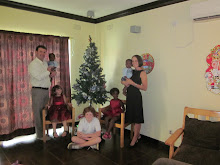
            That night we put the a/c on really high, to make it feel cold, put some barely-audible Christmas tunes on the iPad, drank some hot chocolate, ate warm homemade snickerdoodles, and decorated the tree.  The children honestly didn’t seem to notice how pathetic it was.  They carefully hung makeshift ornaments from paper gift tags and enthusiastically hurled tinsel at the branches, all the while exclaiming about how beautiful our Christmas tree was.  We bought some spray-on snow and wrote “Merry Christmas” on our glass door, and covered it with pictures of snowmen and presents. Then we sang some of the more boisterous Christmas carols at the tops of our voices.  After the shiny silver garlands and smiling plastic (albeit slightly scary) Santa head were hung on the walls, it actually looked festive.
            Of course our kitten Nahla, considering the tree a worthy adversary given its size, lodged relentless assaults on it throughout the night and into the next morning, scoring significant damages.  We eventually lifted the (unimaginably) more pathetic remains of our Malawian Christmas tree onto a desk and out of reach, and that is where it stands today.  The giant Santa-head on our front door fell off almost immediately (which was OK), but at least some of the garland remains on the walls, despite the countless gun battles that take place in our living room each day.  All in all, the living room reflects my current mood: a little disheveled, relentlessly besieged by children, but determined to be festive.

Sunday, November 13, 2011

And now we are seven...

Soooo.  Kenneth.  I am sorry that I have not written sooner.  It has been a confusing, emotional, exhausting month.  Kenneth stayed with us for almost three weeks, and he grew at a rapid pace.  Within a week he had cheeks you could pinch, and after two weeks he almost looked like he had buttocks.  He was a voracious and demanding consumer of formula, finishing a can every 2 days, and reluctantly finishing the sachets of high-calorie Chiponde we forced on him each day (he was not a fan). Within 14 days he gained 50% of his original body weight, going from 3.8 kg to 5.5 kg.  This is the equivalent of Dave gaining 100 lbs in two weeks.   He became stronger and more interactive, and eventually was able to put objects in his mouth and push his little head off the blanket when laid on his belly.  A favorite activity of his was grabbing the sides of my face with both hands and pulling me down to give me sloppy, open-mouthed kisses on the cheek or suck on my chin.
Unfortunately, his perpetual demand for nutrition was not limited to daytime, and Kenneth would wake to take a bottle every 45 minutes to 2 hours, sometimes drinking 20 ounces overnight.  Dave and I developed a system where one of us would sleep in bed with Kenneth and essentially pull an all-nighter, and the other would sleep in a different room and recover from the night before.  It felt like having a newborn at home, but without the maternity leave, while living in a developing country where NOTHING happens easily except sunburns.  We became sleep-deprived, bleary-eyed strangers to each other.  I became very emotionally labile, deciding one afternoon as I trudged home from work on foot in the searing late-afternoon sun, that I no longer wanted to save the world.  I wanted to shop at Target, and go to the movies, and play with my nephews, and take a bath in my beautiful two-person bathtub in North Carolina.  I wanted to run on a treadmill in an air-conditioned gym, and eat peanut butter frozen yogurt, and go for coffee with my mom.  Dave, who became increasingly befuddled but never complained, took the challenge in stride.  The children seemed mostly to enjoy having the baby around, and Malawi proved to be a motherly, doting, reliable little caregiver to him.  Aine would exclaim “Oh I just love him!”, then run off to play with the neighbors.  Eamonn was indifferent at best, and desperate with anxiety at worst, repeatedly begging us not to adopt him.
The backdrop to this dramatic change in our lives was life in Malawi. Grocery shopping literally requires visits to between 5 and 7 different stores in order to buy the routine necessary items, we are both working full-time jobs in busy  facilities with extremely ill patients and few resources, and there has been a severe petrol shortage for weeks.  You never realize how completely dependent you are on cars until someone tells you there will be no gas deliveries to your city for 3 weeks.  Lines at the stations begin with the rumor of fuel delivery, develop within minutes, and can last hours, often ending in disappointment and sometimes bloodshed (no deaths, but some arrests).  Fuel, where to find it, how much it costs on the black market, and how much is left in the tank are constant topics of conversation.  We have become the proud owners of 4-5 jerry cans, dispersed hopefully throughout the city with people who can possibly purchase gasoline for us.  Dave has become proficient at siphoning fuel into the tank.  At the same time that we have had to walk/run to work more frequently, it has become hotter.  By the time I arrive at Baylor each morning my back is soaked in sweat and my face is covered in a layer of perspiration and grime.  For the first time since we arrived, exhausted, hot, and overwhelmed, I wanted to go home.
The situation was not sustainable, and I began to search for a plan.  We had intended to go to the village about 10 days after Kenneth came to our house, but our empty gas tank forced us to put the visit off for another week.  We had finally procured enough petrol from our neighbor that we could drive the hour on dirt roads into the village with Mrs. Chisala, the wise social worker for the Baylor clinic.  Malawi insisted on coming, and Martha the nanny held the baby while I drove.  The directions I made fun of in the last post (left at papaya tree, right at the bigger dirt road) were now the ones I was using to find my way back to Kenneth’s home.  We made a few wrong turns, but eventually arrived at the small grouping of thatch and mud huts, and a large and rapidly-growing crowd of relatives.  Again, we assembled on the bamboo mat, and again I individually greeted each of the adults with a handshake as the family passed the baby around, admiring his weight gain.  I tried to discern if he recognized the people who surrounded him as he stared at them with wide eyes, but I could not.  Again, I was asked to take his twin brother Innocent, and this time I was quick to agree.  He looked terrible.  He was now smaller than Kenneth, and he was limp in the arms of an auntie, unable to lift his head, his cry weak.  Upon further questioning, we learned that the baby had been drinking cow’s milk, diluted with well-water and mixed with sugar.  He was being supervised by his 15 year-old sister and his ancient, kyphotic “go-go”.  As a group, and surrounded by a gaping mass of children,  the aunties, uncles, Mrs. Chisala, Martha, and agreed that the best thing for the boys would be to stay together.  It was also obvious that they could not stay in the village.  The boys’ extended family is able to raise some animals and grow enough food to sustain the adults and bigger kids, but there was no extra money for formula for these two motherless babies.    I explained that could clearly not care for both twins, and it was decided that they should be brought to the Crisis Nursery in Lilongwe, a volunteer-run faith-based home for malnourished children from impoverished families.  Together they would be fed and rehabilitated, then possibly given to foster or adoptive families.  Mrs. Chisala firmly explained to the village, as she had explained to me, that if I did not intend to adopt both boys, then they should not stay in my home at all.  It was obvious that we had developed a close bond with Kenneth in the few short weeks we had shared our home with him, and she warned that he was beginning to see me as “mama”, and that further time together would be lead to emotional devestation when the time came for him to leave our family.  She also felt that, were we to continue to foster him, he would become accustomed to living an “Azungu” lifestyle, with air-conditioning and mosquito nets, and a large variety of clothing and food.  He would go from being doted on and played with and passed around, to surviving.  When I asked Kenneth’ teenaged sister if she would miss her brothers, she said frankly and unapologetically that no, she would be happy to be able to go back to school.
So, decision made and papers signed, we climbed into the dusty truck with the two babies and set off for Lilongwe.   We had to stop at my house to get Kenneth’s formula, clothes, and toys, and to let the kids and Mary (our housekeeper, who had grown to love him) say goodbye.   I cried most of the 45-minute ride back, and Mrs. Chisala consoled me, reminding me that the babies needed to stay together, and that no one expected me to take on the challenge of having 5 (!!) children.   I called Dave, who was at work, and he sadly agreed that the Crisis Nursery was the best place for them.   We had come to be doctors here in Malawi, and our sleep-deprivation was keeping us from functioning well at work.   Plus, our children needed us.  We had just transplanted them to this hot, fuel-deficient city far from their home.  We certainly couldn’t thrust twins on them, even if we thought it was a good idea.
My children were sad saying goodbye to Kenneth, and kissed him on the forehead.   Eamonn asked if Kenneth would find a family to take care of him, and I said that I honestly didn’t know.  My housekeeper, who has something of a flair for the dramatic, collapsed on the ground and sobbed when I told her the baby was leaving.  This, of course, made me cry even more, which of course made the girls cry.   Mrs. Chisala gentled chastised Mary for her theatrics, and restated her belief that, unless we could take both boys, Kenneth and his brother needed to go to the Crisis Nursery.   Reluctantly and quietly hiccupping, Mary agreed with her, but could not say goodbye to the baby, and declined my invitation to come with us to drop him off   .
The Nursery is very pleasant and clean, with colorful murals and clean, well-cared for babies, about 6- 7 to a room with one caregiver, called a “mother”.  I watched as volunteers fed babies, and I told myself that the boys could be very happy here, and that they would obviously be better off than they were in the village.   Still, I was heartbroken as I sat in the rocker with him for the last time. He reached up to grab onto my cheeks and suck on my chin, and tears rolled down my face as I told him goodbye.  Martha sat across from me and inconspicuously wiped her eyes with her chitenge.  Mrs. Chisala spoke with the director, and we left.
 I was exhausted when I returned home, and yet Dave and I threw the bags that Laura had packed for us into the trunk, put the baskets of food that Laura had organized for us into the backseat, and set off for the beach, where we had been planning to go with Kenneth. 
The weekend was wonderful, although we certainly missed the baby.  We stayed in a cottage owned by a friend of a friend, which was right on the lake.   It is simple and basic, but clean, and has a kitchen and three bedrooms (with a/c!).  Two miles down the road is a fancy hotel on a soft, white-sand beach, with a giant swimming pool and paddle boats and kayaks available.  We pay dues to be able to use their facility ($25 per year), so we spent both days playing with the children and swimming in the clear, warm, shallow lake waters.  We relaxed and talked, built sand castles and did cannonballs into the pool.
Over the next week I sometimes thought I heard Kenneth downstairs, cooing or squealing, and I would occasionally ask the kids if they missed him.  The girls always said yes, but Eamonn was usually quiet.  “Don’t worry mom, he’ll be OK, “he would assure me when I was sad, “He’ll be adopted by someone.”  I’m not so sure, I would tell him.  But, honestly, I felt better than I had in weeks.  I was well-rested, and had reasonable personal hygiene once again.  I slept in the same bed as my husband every night.   I was able to do my job and enjoy it.
Wednesday morning when we woke up, there was no water in our house.  We came to learn that the recurrent power outages had led to pump failure at the water board, and the problem was not expected to be fixed until the end the weekend, at the soonest.  In Malawi, I have found that it is generally the rule that one should roughly double any estimates of time and price given by repairmen, so I was not hopeful.  It is amazing the smell that develops when a family of six (including Laura) cannot flush the toilet or wash dishes (or bodies) for 24 hours in the oppressive heat.   So, once again, we planned for a beach trip.  We decided to stop by the nursery to visit the babies before we left that Thursday.
When we arrived, the twins were in separate rooms, with different “mothers”.  No one appeared to be able to tell the difference between the two.  The supply of one of Kenneth’s TB medicines and the pill cutter we had left were gone completely, and he had been given several days worth of the second medication at 4 times its correct dose.  He seemed to have lost his chatty demeanor, and only began to smile after 30 minutes of holding him.  The record books where information about the children was written stated that “unknown baby” (Innocent) had been having continued fevers and had not gained any weight in the week he had been there.  He had been given Tylenol and a few days of antibiotics, but when we picked him up his skin was on fire.  Dave and I set off for Baylor to get malaria and TB medicine for Innocent, as it was very possible that he was suffering from the tuberculosis that had infected his brother and killed his mother.   Although the babies had clearly been getting fed and changed and attended to, it was obvious that they were not being loved by a family.  It is impossible for a woman in charge of 7 malnourished children for a 12-hour shift each day to provide the same quality of care that living with a family can.  As we mixed the medicines and demonstrated the dosing to the caregivers and wrote in the book clear instructions for their administration, I looked at Dave with tears in my eyes.  “What do we do?” I asked.  “I’ve already decided,” he replied.
The first day at the beach, where we were staying at a lodge with the families in our complex, all of whom were also without water, I talked with Dave.  He was right, and although the idea filled me with anxiety and I couldn’t believe I was considering it, we began to plan to take Kenneth and his brother home.  Two problems were paramount:  the big kids, and the sleep issue.  We carefully plotted how to tell Eamonn, and I fretted about hurting him and felt guilt that he might feel burdened and overwhelmed and unloved.  And we decided that we needed a night nanny.  There was absolutely no way that we could function as parents or employees if we didn’t sleep regularly.  We decided that, here in Malawi, we were the Jolie-Pitts, and we could have the full-time staff that the wealthy in our country do.  To hire a full-time caregiver/housekeeper in Lilongwe costs about $70/month, and we usually grossly “overpay” our helpers at $125/month, so the financial burden would not be so high.  We started making calls, and soon found a potential daytime nanny, and confirmed with Martha that she could take care of the twins at night.  We spoke with Mary, to be sure that she could cover during the first week, while we were waiting for reinforcements. She, of course, was happy to help make it possible to bring Kenneth home. 
We spoke to Laura first, and although she reiterated that we were functionally insane, she was on board.  We then pulled sweet Eamonn aside that Friday afternoon on the terrace restaurant at the hotel and told him of our plans.  We explained that it was truly unlikely that the babies would find a home, and that their future was bleak if they survived and returned to the village, where they would be two of a score of children being essentially cared for by other children.  We told him that his support was critical, and reminded him how his sisters were inclined to adopt his opinions, and would be as accepting or rejecting as they thought he was of the idea.  We admitted that he had us in the palm of his hand, and jokingly offered to buy him electronic in exchange for his endorsement.  And my good, kind little boy agreed that we should bring the twins home.   He was understandably worried about the details, ranging from their college educations (?!) to whether he’d have to change dirty diapers, and we tried to answer all of his questions honestly and openly.
Together we told the girls the next day, and they first looked at Eamonn to see his reaction.  When he said, “I think it will be fun!  Two more minions for the Fitzgerald army…now we REALLY outnumber the grown-ups!”  they smiled, and it became official.  We were going to be a family of seven.
We brought  Kennedy Adam (we weren’t fans of the name Kenneth) and Shane Peter (formerly Innocent- he would’ve been beat up with that name in the US) home a week ago today.  How has it gone?  Well, better than I would have thought.  My children are phenomenal little people, and have embraced these tiny boys with a love and acceptance that fills my heart with pride and gratitude.  They play with them, feed them, hold them, and coo over them.  The almost round-the-clock staff we have employed (3 nannies, a housekeeper, and a lawn person) are essential, and the night nanny in particular is the key to our survival.  It is definitely chaotic, and I spend much of my time covered in food and baby drool, never have a minute to myself, and frequently feel incompetent and guilty in all forums of my life, but that is really status quo.  Every day I am growing to love these babies more, and I see my family doing the same.  I love their sweet fuzzy heads, and kissing their little necks, and feeling their weight on my shoulder. I feel renewed love for my husband and his generous heart, and I am in awe of the Fitzgerald kids.  I am overwhelmed, for sure, but taking it day by day.  What else can you do?

Monday, October 17, 2011

The Stranger in my Bed

I lie in my bed with him in my arms, his wide, wet eyes staring, guileless and unblinking, into mine as I feed him. He is 8 months old and weighs about 8 lbs, the average weight of a newborn. He cannot sit up or roll over. His cry is weak and raspy. But he reaches his long, thin fingers out towards my face and lays his hand on my cheek as he eats, and I am in love.
His name is Kenneth, and I have brought him home from the Nutritional Rehabilitation Unit (or NRU) to try to help him grow and gain weight-really to increase his chances of survival. Perhaps it is a bad omen that, my first week in the hospital on wards, I have managed to bring a baby home. Truthfully I am not even sure how it happened, but here he is, lying in my bed, greedily sucking down a formula bottle at two o'clock in the morning. He is a twin, and the last of six children. His mom died, it sounds as though it was from TB, on September 30th, and he was brought to the hospital by his aunt. I would visit him each day on rounds, and despite his profound cachexia, he would smile endearingly up at me when I talked to him, and giggle when I examined his swollen belly. His aunt, who is only 47 but looks as though she is in her sixties, told me the story of how he lost his mom, and explained that they are now caring for his 5 siblings, in addition to her own 8 kids. Somehow my half-joking offer to take him home with me became a serious conversation between his auntie and my translator, and it was made clear that she would be grateful for the help. My sweet, insane, wonderful husband was not only supportive, but enthusiastic about the idea. And so, last Sunday, I found myself driving with our family, Kenneth and his auntie, and Yvonne, the translator, to his village in the middle of nowhere to discuss with his family the matter of our fostering this fragile little person. We took directions as we drove, in order to be able to find our way home, which read "left at the mango tree", and "right at the giant dirt mound". And then, upon arriving at the village, we sat on a giant straw mat, surrounded by at least 20 kids and an equal number of adults (each of whose hands we all had to individually shake), and talked about this little boy. In the Central region it is customary for the maternal uncle to make decisions about the children's welfare, even when both parents are present. Kenneth's dad is alive, but is very ill, and had left to go back to his home village for care. The uncle agreed, both verbally and on paper, that caring properly for the baby was beyond their capacity, and that we should be his temporary guardians. An elderly woman with rheumy eyes and skeletal hands, who would apparently have been his primary caregiver, kept grasping my hands and thanking me in Chichewa. in fact, rather than resist our request to temporarily provide for Kenneth, we were asked several times if we could also take his twin brother. He looked fairly healthy, however, and I still had some semblance of sanity left, so I gently but firmly refused. We took pictures of the relatives, and one of the twins together. They reached out to each other, and it seemed obvious that they recognized each other. And then we left, and took this emaciated, developmentally delayed, delicate little person home and into our lives and our hearts.
Dave and I had forgotten what it is like to have a newborn, but that is essentially what he is. He eats every 2-3 hours, even through the night, and he is incapable of rolling over or sitting up. His wasted little body is both tragic and terrifying, and when we change his diaper (which is newborn size and floats on him) he cries so hard, and brings his spindly little fingers together to wring his hands in helpless desperation. His upper arm circumference is, without exaggeration, the size of Dave's index finger. We are treating him for TB, so we have to give him his medicine every morning, and he has a food supplement called chiponde, which is like peanut butter thickened with oil and milk powder and sugar, that he is required to eat every day in order to help him gain weight. He is not a fan. He much prefers the formula we make, which he sucks down in great quantity, and seems to excrete into his diaper at a remarkable pace.
Our lives have, predictably, descended into chaos. We are fortunate enough that hiring an extra nanny for him only costs about $125 per month, so he is cared for while we are at work without any additional strain on Laura or the kids. But he wakes at 4:30 am, and cannot really be put down for long, and frequently soils the few clothes we have for him. So we are sleep deprived and have more dishes and laundry to do, and we feel like we are neglecting our kids. And yet, when he is well fed and clean he smiles the most beautiful gummy smile, his ridiculously big brown eyes locked with mine and his tapered fingers reaching for my face, and all the sleeplessness and chaos is momentarily forgotten. The Fitzgerald children, who have been generous with both their love and that of their parents, do not forget the inconveniences as easily, and we are anxiously asked multiple times per day whether we plan to adopt him. The truth is, I do not know what the future holds. I am trying to take it day by day. I plan to go with our clinic social worker on Tuesday to the village, to see what his home situation would be like. I am truly conflicted about what is best, both for him and for our family. I know I absolutely cannot take care of 1 year old twins. Life here is challenging enough, even with the help of our housekeeper and nannies (Dave spent 7 hours on line yesterday waiting for petrol while I was home with the four kids. He was not successful.) Yet we know we could never take one baby out of poverty, into luxury, and leave his twin brother at home in the village. We have discussed the possibility of supporting the orphaned children, providing them with mosquito nets and fertilizer and school fees, in short "adopting" their family. But meanwhile, this sweet little boy is bonding with me and with our family as he grows stronger, sleeping in an air-conditioned room in soft clean clothes with a belly full of formula (which cannot be provided in the village without our help and a source of clean water), and it seems as though it is increasingly unfair to send him back home away from all that we are currently providing. I do not want him to bond with me and then lose me, as he lost his mother only a few short weeks ago.
I think I will know better once we go to the village on Tuesday. In the meantime, as I tell the kids whenever they ask, I am waiting for God to tell me what to do.

Sunday, October 16, 2011

A lesson

I love Malawi.
Yesterday my children were sick, and I was worried about them. Nothing serious, but low-grade fevers and low energy, and I wanted to be with them and tend to them. Luckily, clinic wasn't busy and we finished early. I did not have the car, however, as Dave had dropped me off in the morning. Most days I walked, but that morning. I frequently walk or jog the commute between Baylor and home, but that day I had thoughtlessly failed to plan ahead, and had not brought comfortable walking shoes. I called Dave from work, already knowing that he probably would not be ready to go for quite some time, but wondering if we could make a plan so that I could get home to the kids as soon as possible. There was no answer. I tried again. And again. I became irritated that he was not picking up the phone, and grumpily set off in my highish-heel work shoes in the hot afternoon sun.
The streets and "sidewalks" (I use this term VERY loosely) in Lilongwe are uneven, pock-marked dusty orange paths, and as I stumbled the 3 miles home, my frustration and anger grew. Why do I always have to figure out how to get home? Why does Dave always get the car? Why the @-/?!$ doesn't he ever answer his phone? Why the @&$?! cant Lilongwe have some more decent paths to walk on? My dress was sweaty beneath my backpack, my face was burning in the heat, and my
ankles were twisting beneath me as I dodged the vendors in the markets and the cyclists who challenged me for space on the path.
"Good afternoon, Madam," I heard from behind me, and I lifted my head from my disgruntled inner monologue. Passing me on my right on a make shift, hand-operated bicycle-wheelchair of wood and rusted metal, came a man with no legs.