Tuesday, June 19, 2012

Going home.

Circumstances have conspired to leave me alone in front of the computer, with no access to internet and little excuse for not writing.  It is, of course, not unusual to be without the internet.  That happens every night.  It is the fact that I am alone.  All 5 kids are sleeping, and Dave is out at his clinic seeing a patient (rare).  So many times this year I have written blogs in my head, or even started them on the computer, but our lives are so chaotic and full that only occasionally do I finish and post anything.  There have been so many emotions this year that I know have gone undocumented.  There have been so many changes that I have not taken the time to reflect on. 
                For the last several months I have been in a better place.  I think it is the sad but inevitable result of being surrounded by poverty and illness:  eventually you don’t cry over every death.  The patients and the people are always affecting, and there are still some that put me over the emotional edge, but I have been more able to go on with my life, without being thrown into a major depression with every bad outcome.  Similarly, the hassles of life here have become routine, and we have learned both short cuts for and to have patience with the idiosincracies of Malawi.  It has also helped that the former president, who many believed bordered on dictatorial, had a heart attack, and was replaced by one of his rivals, a woman named Joyce Banda.  Fuel lines have been better, and there are less scary-looking police thugs roaming the streets with guns, although the store shelves remain half-empty, and the value of the kwacha just dropped 40%.  I also think it really helped my outlook that I knew I was going home soon.  There appeared to be a light at the end of the tunnel of our life here.
 Unfortunately, my glow of tolerance has dimmed.  It began to fade when I realized that this trip is no “light at the end of the tunnel “.   It is a window, letting some liver of light into a dark, somewhat claustrophobic tunnel that we have only half-way traversed.  I don’t mean to sound melodramatic (well maybe I do), but when it dawned on me that we would be returning to Malawi after our vacation, with a renewed sense of all that we are sacrificing and missing, and without the sheen of novelty to ease the transition, I started to get depressed.   As the date of our voyage has loomed nearer, my funk has grown.   
The hole that the absence of my family has left in my heart is huge.   I am almost afraid to see them again.  I’m afraid of having to try to distill two years’ worth of experience and growth and change and love into just a few days.  I’m afraid to remember what it is like to spend time with them, to watch our children run around my yard again, to laugh and reminisce and hug, I’m afraid that every family dinner, every shared joke and shared beer will be tinged with sadness, because it will be the last for another year, and it has already been so long.  I’m afraid of saying good-bye again.
And, the truth be told, I’m tired of life here sometimes, and the thought of coming back to the same stressors make me anxious and sad.  We are going broke; it is ridiculously expensive here, and is only getting more so.  The economy has gone through so much since our arrival that the price of most foods has literally doubled in the last year, and in some cases it has tripled.  We are now spending $170 USD to fill our gas tank.  We have had to give our nannies 40% raises, to compensate for the devaluation of the kwacha.  Electricity is through the roof.  We have been living off of the money that we saved before we came, and we have gone through it at a startling rate.  I am worried we won’t survive financially for another year, and I’m terrified of going back penniless and with huge credit card debt. 
There’s a side to living in a place like this that I think you don’t appreciate unless you experience it, which can be uncomfortable to explain.   I know that I am blessed to be in the position of giver, and it can also be frustrating and overwhelming.  Sometimes I feel like an ATM.  There are so many people, and they need so much.  My measure of poverty is this:  if another human being will eat the discarded food from your plate, then they are poor.  There are literally scores of children, kids the same age as my own, who live on the streets and eagerly accept our scraps.  And I know that I should be (and I am) so very, very grateful to be the one giving, but sometimes, especially in light of our own financial concerns,  I wish people would stop asking for so much.  I wish I wasn’t such an obvious target.  By virtue of my color, I cannot walk 2 feet without being offered something for sale, asked for money, or asked for a job.  I try to understand.  I am walking opportunity.  But being an Azungu in Malawi can be like being a giant dollar sign with appendages.  I long for anonymity.
Tomorrow we go home.  Once again I will see my family, laugh on my porch deck with my brothers, watch our kids run around on the front lawn together, hug my mom and my little brother and sister.  Once again I will have good food to eat, and tons of it.  I am going to eat ice cream or frozen yogurt every single day.  I am going to eat Thai food, go to salad bars, drink fountain soda, and eat Twizzlers until I vomit.  I am going to drink Starbucks twice a day.  Once again, I will have entertainment, and exposure to American culture.  I will go to the movies at least twice per week. I will take my kids to the Life Science Museum, and the beach, and to see friends and swim in the pool.  I will go to the air-conditioned gym EVERY DAY.  I am going to live a life of convenience and consumerism and comfort, and I am going to try to love every single minute of it.
And then I’ll come back. 

Monday, May 14, 2012

Mayhem after Midnight

It is incredibly hard to find time to write, despite my best intentions and the numerous adventures that occur on a regular basis, which I promise myself I will commit to paper. Or keyboard. In my defense, I am getting over a recent bought of influenza, followed closely by my first pneumonia. One of the sequelae of working in a place that does not have a lot of soap or hand sanitizer, where I spend my time in an over-crowded hospital ward, filled with coughing, vomiting, sweating, and urinating children, is that I am exposed to a variety of illnesses.  In spite of my best efforts, I have found myself almost constantly ill with some form of gastrointestinal or respiratory illness from the month we arrived.  Our lives are so busy and so filled with children and work that each illness seems to take forever to recover from.  My exercise tolerance has plummeted; my energy level has hit rock-bottom. It doesn’t help that no matter how hard we try, Dave and I are unable to get a good night’s sleep.  Sleep has become the Holy Grail in our lives.  So desperate are we for a night of uninterrupted slumber, that we stay in a hotel once a month in order to catch up on our REMs (we call it “date-night”, and pretend that we do grown-up things like go out to dinner, but no parent would be shocked that the prospect of sleep is sometimes more exciting to us than that of romance).
Last month ended with a safari trip to Zambia, with my good friend Tamika (another blog entry I intend to write), where our entourage passed influenza from one to the other, for the duration of the very expensive trip. I had it first, and recovered pretty quickly, but then started a week in the wards when we returned home, and my health rapidly deteriorated.  I did not realize that the malaise and cough and chest pain that I was developing was pneumonia until I came home from my weekly ER shift with a fever.  The next day at work I had a nurse in the clinic give me IV Ceftriaxone, and I went home that afternoon, resolved to get a restful night’s sleep.  I slugged a shot of a magical tonic that Dave bought, over-the-counter, for cough.  A potent combination of Benadryl and Codeine, I think it’s mechanism of action is pure sedation, with possible suppression of the respiratory drive.  (No FDA here- it has children’s dosing on the label down to 2 years old).  I chased this with a handful of Ibuprofen, put soft jammies on, and curled up in my bed with my earplugs in.  I drifted off into peaceful sleep.  To give you some indication of the recent state of my subconscious:  I was having a delightful dream about grocery shopping in a magical, air-conditioned supermarket, with shelves actually full of food, and aisles bursting with variety and color.  In this idyllic wonderland (which could have been any store in the US), I was able to buy every ingredient I needed for dinner in one place, and was even given choices between different brands for many items.
Suddenly, a shrill, screaming sound filled the air, and I was startled awake.  Dave sat up in bed next to me.
“What is that?”
The sound was incredibly loud, and appeared to be coming from our attic crawl-space.  We quickly determined that it had to be our alarm system going off.  Here in Lilongwe, there is not really a 911 that can be called.  The government is so broke that if you call the emergency number and ask for help, they ask you to please send someone to pick them up. This is in a country where people are desperate for “Forex”, or American dollars, and where being an Azungu means being obviously, noticeably different and presumably well-off.  Therefore many foreigners, including ourselves, opt to hire local security companies to protect them.  Our apartment complex has a big metal gate and 24 hour guards, and we have a panic-button installed in our house.  It looks like a doorbell, is in the corners of several rooms and the hallways, and if pushed will summon a crew of goons who show up in full-battle gear with helmets and batons to fight whatever bad guys might be hassling you.
Dave pushed the mosquito net aside and stumbled over the children, who had camped out on our floor for “Family Night”, pulling pants and a shirt on and heading for the door.  Eamonn sat up as he left the bedroom.
“What’s that noise, mom?” he asked groggily.   Determined to go back to my grocery store paradise, and committed to my night’s sleep, I refused to allow myself to completely regain consciousness.
“It’s just the alarm system going crazy. Daddy will fix it. Go back to sleep.” 
But a few minutes passed and the shrill sound continued unabated.  Aine and Malawi sat up, and Aine (who has been going through a “sensitive” phase) immediately began to hyperventilate and cry in panic.  Malawi, who does whatever her sister does, followed suit.  Amid the escalating wails of my children I went outside to find Dave, hunched over the computer, desperately trying to find the number of our security company.  I looked at the time: 3:45 am.  Although we were unsuccessful in our search for the number I was not especially worried, as I was expecting that the goons would arrive momentarily in response to the alarm.  15 minutes passed, during which time both my anxiety and that of my near-frantic children increased, as no security team arrived and no number was found and the deafening siren sound continued. The twins began to cry from their room.  My friend Tamika came in from the guest room, rubbing her eyes.  We began to get texts from the neighbors, making sure we were alright.  And still, the horrible screeching sound persisted.  Unsure why the goon squad had not come, and unable to contact the company by phone, we pushed the alarm button in the hallway repeatedly, while trying to maintain a forced cheerfulness to soothe our wailing girls.
I took the babies out of their cribs and changed them, as Dave climbed onto a chair and tried to reach the system in the crawl space above our second floor.  Using a broom handle, he attempted to rip the wires from the wall.  The electricity went out.  The piercing noise persisted. The big kids continued crying as the babies crawled merrily around the living room, apparently awake for the day and ready for business.  It was now about 5 am. 
Suddenly, a covered vehicle with about 10 men dressed in combat gear, with helmets and batons, arrived at our door, ready to fight.  They traipsed into our house in procession and examined the situation. Several phone calls were made to the home office (using our phone, because none of our hired thugs had a functional phone). Dave demanded that a technician be sent immediately, as the sound was unbearable, and we were all in need of sleep. Further discussions ensued until, at about 5:30 am, we were told by the technician in the home office that we did not have an alarm with sound.  Ours was a silent alarm.  My genius husband investigated further, after apologetically dismissing our personal army and requesting that the company send someone during the week to repair the system we had unwittingly destroyed with our broom, and discovered that our plumbing system was responsible for the caucophony.  The pressure in the pipes had built to such a point that it was causing them to vibrate against one another, resulting in the horrific sound.  The solution, after 2 hours of sleeplessness and much distress, was simply to run the water.  He left a faucet running (a phenomenon which usually causes me much angst), we gave the children some Melatonin and the babies a bottle, and we all went back to bed.
I’m not sure what the “moral” of this story is…perhaps it is that I am destined to never have a good night’s sleep.  Or maybe it is that sometimes life here is surreal.  As I watched the crew of armed guards track mud from their combat boots on my carpeted stairs, a twin on each of my hips at the crack of dawn, it occurred to me, once again, that life in Malawi is never, ever boring. It is unpredictable, frustrating, rewarding, heartbreaking, and challenging, but it is never boring.  

Thursday, March 15, 2012

Primates on the Playground

For most of my life my mother has been afraid of flying.  She is a homebody by nature, whose idea of traveling is going to the Durham Super Target.  She is happiest when she is in snuggly pajamas, in her beautiful living room, with her protein milkshakes and a good book.  For decades she has supported but never truly understood my wanderlust or my desire to live and work in Africa.  And yet, over the age of 60, she recently boarded a flight that took her into the air for over 12 hours, across an ocean, to a foreign place with a blazing sun and perpetual shortages of petrol, electricity, and water.  I think that God recognized her effort, because the heavens rewarded her courage with unseasonably cool weather, and a plethora of petrol for the duration of her visit. The ONLY time that I have ever driven up to a gas station and filled my tank without waiting was shortly after her arrival.   By comparison, since she left we were without a car for more than a week, because no one could find fuel and our tank was empty.
My mother and Kennedy fell instantly in love, and she carried him everywhere, which seemed sweet at the time, but has left us all with a 23 lb baby who thinks he needs to be held constantly.  She was the hit of the party when we visited the boys’ village, and was surrounded by a crowd of jostling children eager to have their picture taken with her camera. We have an entire series now of village children, including several with my mom seen grinning in the middle of a crowd of 30 kids. She was affected greatly when we visited Chrissy at PIH, where she had been admitted again for likely TB in her abdomen. My mom was heartbroken when we visited Chrissy’s home to check on the her motherless children, where the 12 year old brother is the breadwinner and the 10 year old sister the surrogate mother. She cheerfully survived power outages, water shortages, and long hours of crying babies and a house full of kids. I am extremely proud of her.
As my mother quickly learned, one of the greater challenges when living abroad in the developing world is, believe it or not, boredom. Petrol is a constant issue, and the ordeal that one has to go through in order to fill the tank makes us reluctant to use fuel for recreational purposes. We pay someone to wait on line for gas for our truck while we are at work, and he recently waited for three days on different petrol queues but was unable to get more than ½ gallon. People start lining the streets with cars outside the petrol stations at the merest rumor that gas might be arriving, and traffic builds up, often to the point of blocking the roads in both directions. The gas stations are volatile places, where fights break out over the order of the jerry cans, and who has been waiting longest.  The police and army often patrol in order to maintain peace and order, but the crowds can sometimes be intimidating.  So we try not to do a lot more driving than necessary. 
Home is also definitely the easiest place to be for a family of seven. The energy required to leave the home is enormous.  Getting all 5 children and two adults dressed, with shoes on, with full bellies and empty bladders, strapped into their car seats or seatbelts and off on an adventure is an operation requiring careful coordination, and not to be undertaken lightly. Even if we had fuel and were motivated enough to wrestle the children into the car, there is really nowhere to go.  There are no parks or playgrounds, certainly no museums or movie theaters, and definitely no arcades or adventure centers. Over the months we have lived here we have discovered a very few places that we can take the children.
And yet, my patient mother had to get out of the house once in a while.  And, miraculously, the fuel crisis had temporarily eased, leaving us with a full tank.  So, feeling generous and anxious to entertain my housebound mom, I planned a trip to the Lilongwe Wildlife Center.
This is a beautiful preserve in the middle of Lilongwe, where they have one of the best (and only) playgrounds in the city. It has a wooden fort with stairs and balance beams and swings, and there is a gigantic hill of dirt with a climbing rope anchored to the top. There are large swinging benches on a wooden platform, surrounded by a small picnic area.  Just past the playground is a path that leads for several kilometers in a circle, where crocodiles, lions, and monkeys are kept, often after rehabilitation. It is a great place, where we held the girls’ birthday party in December. The employees played “Musical Chairs” and other games with the children, painted their faces, and took them on a short tour of the park to see some animals. 
So off we went, arriving after work one Tuesday afternoon, and accompanied by Aine’s bestfriendClaire (as she says it) and our nanny Laura.  We had packed carefully, and planned on feeding pb and j sandwiches to the twins while the big kids played.  Immediately upon arrival the children raced to the mound of dirt and began climbing, as the adults wrangled the babies out of their car seats and into their strollers, then maneuvered them down an embankment to the playground.  After settling down on the swing, we took our food out of the plastic shopping bags and began chatting.  A few minutes later Laura interrupted the conversation to say, “I didn’t know there were monkeys roaming free here,” and I turned my head.  A group of 5 or 6 monkeys, each about the size of a toddler, was approaching the hill where the children were climbing.  The children noticed when I did, and began scrambling down quickly, sliding in the dirt and running toward me in a near-panic.   Having traveled and lived in Africa and India, I am not too afraid of monkeys. Just the previous weekend we had taken my mom to the Zomba Plateau, and a baboon mama, with a baby clinging to her belly, had stolen a croissant off of Malawi’s plate at breakfast. So I found the sight of my children fleeing from the monkeys with arms flailing and mouths open in screams of terror funny, and began to laugh.  My mom, also amused, took pictures of the primates approaching her panicked grandchildren, while Laura continued to feed the babies bits of sandwich.  I stopped laughing when I realized that the monkeys were also descending the hill, and were heading down the embankment toward the playground. I made a hissing sound and raised my hand, then feigned brandishing a weapon as I scanned the ground looking for an actual stick to wave in the air.  This is a technique which I had seen many Africans use, and which usually seemed to frighten animals off.  Yet these monkeys were indifferent to my display, and continued to advance.  The biggest one, who led the approach, bared his considerably sharp teeth at me and returned a hiss. The children began to panic in earnest behind me.  Although I was still (mostly) certain that nothing would happen, this pack of monkeys was not acting as they should act when confronted by humans. In fact, the leader jumped up on the top of one of the swinging benches, looked down at us and hissed again as we scurried out of his way.  My children began to scream. My mom, apparently oblivious to the escalating danger, continued to take pictures.  I began to yell for help.
 I was trying to shout, in Chichewa, in a way that would capture the attention of the park employees, but not contribute to the anxiety levels of my whimpering, crying, and occasionally screaming children.  There was a group of Malawian gardeners pulling weeds about 50 feet from us, but they did not look up. “Excuse me,” I yelled in my faltering Chichewa. “Monkeys coming.”
No response.  Meanwhile, the leader monkey advanced, still growling, and my children screamed louder and tried to hide between me and the wall behind me.  My heart rate increased, and I began to yell again, louder this time, and less concerned about how I sounded.
“Monkeys coming. Please! Excuse me! Excuse me!” I repeated, my voice growing hoarse. Finally one of the men looked up from his work and noticed the cowering, frantically gesturing Azungus down the hill.  He clearly did not understand us, however, and was somehow unclear about our need for help.  Apparently he did not see the menacing pack of primates that was openly threatening us. He turned to his friend for a second opinion about what, exactly, we might be saying, as the fanged monkey leered at us and crouched as though he was about to leap.  I tried to be courageous, and put my kids (and mother, who had finally stopped taking pictures) behind me, readying myself for the oncoming assault.  At that moment, however, the manager appeared, having been summoned by another one of the gardeners who found our bizarre behavior disturbing enough to seek help.  The manager, thank God, immediately deciphered the situation, and walked down the embankment toward us, scattering monkeys as he approached. The pack scampered to the forest and climbed the nearby trees, then looked down at us in disdain.
My heart still pounding and my throat sore from my barely muted shouts of panic, I quickly realized that if I did not convince my children to stay at the playground for a few minutes now that safety had been restored, they would never again return to the Lilongwe Wildlife Center.  And that would be a shame, because it is a great place. And we had just spent 14,000 Malawi Kwacha for a family membership.  I tried to point out that we had been attacked because we were feeding the twins their lunch, which the animals wanted.  It was also very deserted that day, as Tuesdays are apparently a day that the park is short-staffed.  I attempted to convince them to take a walk with a park ranger, with whom we would be perfectly safe, so they could see that it is a great place to hike and enjoy nature and the enclosed animals, but they would have nothing of it.  They were truly traumatized by the event, and they cried and begged me to take them home with such looks of desperation and such fear in their voices that I had to comply.  Even Claire, who is South African and pretty tough, was terrorized.  They clung to me as we walked to the car, staring with wide eyes up into the trees as they held my elbow, searching for monkeys, then dove into the car and slammed the doors. It wasn’t until we were all comfortably inside, windows closed and doors locked, that the story became funny.
Who needs museums and zoos when you live in Africa?

Wednesday, February 15, 2012

The wet season: A tribute to love and drool

I am sitting on our bed, under a gently undulating sheer white mosquito net, my feet entangled with Dave’s, and the house uncharacteristically quiet. It sounds romantic, but in reality the %$& mosquito net is flecked with the smeared bodies of flattened mosquitoes, and is perpetually getting wrapped around my head or draped across my face and obscuring my vision as I write.  The big kids are in a room down the hall together. My mother, who is visiting, is in the room that Martha and the twins usually share. Right now she is downstairs with Laura, who often spends her evenings wrestling with the internet, trying to Skype or use Facebook. The twins are asleep in the playroom while my mom is visiting, which is a little less than ideal because it is right in the front of the house, is filled with toys, and has no door. Nonetheless, they have settled into slumber. It is the time of day when Dave and I fall into our beds breathing a collective sigh of relief and try very hard to stay awake long enough to have a conversation (usually about the logistics of the next day) or do work on the computer. Our days are filled to capacity with love and noise and work, and the riotous chaos of five growing children. When night hits the house like a stone (with the help of an occasional Melatonin) Dave and I have an hour or two before we, too, collapse beneath the weight of our busy lives and sleep.  I believe we are happy.
The babies are growing so fast it is astonishing, and the size difference between the two of them is becoming more apparent. Shaney (I call him Shaney because, to me, Shane will always be my brilliant, sarcastic bald-headed little brother) is a peanut, and Kennedy grows more massive every day. For a while feeding him was a challenge, as it could not be done fast enough to meet his demands; he would shriek if we paused even momentarily.  At one point he was actively choking on some food, and simultaneously attempting to scream and reach for the fork we had put down in preparation for performing the Heimlich on him.   We joke that he will soon be the first human being to go from severe acute malnutrition to morbid obesity in less than 6 months. Their development has been miraculous. They have both hurdled several milestones in just the last few weeks: they clap, crawl, and Shane can wave bye-bye and shake his head “no”. In fact, he has developed an entertaining but somewhat disconcerting habit of shaking his head rapidly back and forth until he gets dizzy and dazed. Until recently Kennedy could not crawl because he was just too fat, so he would roll from place to place, but they are now both proficient crawlers; they have even recently successfully attempted to climb the first two stairs to the second floor.  Our whole lives are changing, as they have become mobile and willful, driven by the insatiable desire to put the most disgusting, hair-raising objects into their mouths after digging them up from the tracks of the screen door. (And yet, offered a banana, Shane emphatically shakes his head “no” until his eyes roll).  They are so loving and so sweet.  When I walk in the house after work it is a race across the room on dimpled knees to be picked up first, then giant open-mouthed, drool-laden kisses on my chin and face.  The big kids truly love the babies, and are remarkably tolerant and doting.  Together our family applauded as they waved for the first time, and together we cheered the first time they crawled.  Our little twins are constantly smothered with kisses and entertained and carried and tickled.   I believe they are happy.
Eamonn has matured so much since we arrived in Malawi.  He remains a shy, somewhat introverted boy, happy to stay in the library reading a book with a few friends during free time at school.  Although he has recently developed the dry, know-it-all attitude of the pre-teen, he has also revealed himself to be a patient and genuinely loving big brother, especially to the twins.  Today, on his way home from karate (which Malawi calls “Ninja”)  he even commented on the fact that he is fortunate to be living in Africa, and that he recognizes that his life is an adventure that few kids his age ever experience.  I believe he is happy.
Malawi, who still insists on wearing thick fleece hoodies in the stifling African heat, has also grown taller and more mature.  She is probably the most self-sufficient of my children, and is fiercely independent.  For the first few months she treated the twins like her baby dolls, frequently changing their outfits and force-feeding them bottles. Her career as a surrogate mother ended when it was discovered that she had left the house with a baby in her arms and walked down the cobblestone driveway with him to the neighbor’s house.  She is relentlessly chatty, from the moment she awakens in the pre-dawn hours, and is a tough little survivor who challenges even her big brother, who is several times her size. I believe she is happy.
It has not all been roses and butterflies.  I had my conferences for the kids’ school, and was told by Aine’s concerned teacher that she has been needier recently, and (while happy), she is not as well-behaved as she had been, and seems to be craving attention.  I, too, had noticed a difference in Aine’s behavior, as she has lately been very dramatic and prone to meltdowns.  I have also witnessed a time or two when she has been a little rougher than necessary with the babies, or given them a little tweak as she passed, which has made me worry.  Aine has typically been a bright, silly little girl filled with giggles and curiosity.   She slept in my bed and breastfed until she was 2 ½, when I reluctantly stopped because she had started to wrestle with me for access to my breasts in public.  Since that time, she has always needed a certain amount of physical contact with me.  She has told me a several in the last few weeks that she needed more “Mama-Aine time”, once handing me a note on pink construction paper that said, in crayon, “Mama, I need Snuggle. Aine”.   I worry that she is not happy.
After that conference I felt disconnected from my childrens’ lives and incompetent as a mother.  For the previous two years at home I had been a part-time physician, working only 3 days per week.  I spent days in the children’s classroom each month, and tried to go on their class field trips.  In Malawi, I work fulltime and often have to wait for transport or walk home, so that I rarely return before 5.  Plus, now we have two adorable, drooling, time-consuming, babies to take care of, and life here is logistically a lot more complicated.  Grocery shopping routinely takes 3 hours, paying rent requires changing money on the black market then waiting in line at the bank with 759,000 Kwacha in a knapsack to be deposited.  My heart was heavy with guilt and resolve, to be a better mother, to buy a bike so that I could get home earlier, to try even harder to spend quality time with each and every one of them. 
Luckily, I have Dave, and he is my hero.  When I have a nervous breakdown over having to spend the 1 ½ hours I have at home with the kids making dinner, he says, “I’ll make Mexican.”  When it is Martha’s night off and I am bleary-eyed with fatigue he says, “I’ll get up with the babies tonight.”  And when we are hit with the overwhelming scent of a “Code Brown”, he says, “I’ll change his diaper.”  Living and working here, with all of our children, requires a degree of unity and teamwork that I didn’t previously imagine we were capable of.  I thank God for him and for my marriage every day.  I believe he is happy.

Hmm, what about me?  My life at work has its rewards and challenges.  I have managed to maintain (what’s left of) my sanity recently because I have not been in the wards since just after Christmas.  It is there that the mortality rate is high and the conditions are abhorrent.  In the Baylor clinic most of our patients are well, albeit HIV-infected.  We see starving and TB ravaged kids every day, but the numbers are smaller and therefore not so overwhelming. I recently had a Baylor professor liken what we are doing to being on the front lines of a war, where the enemy is poverty and the bullets are disease and hunger, and I find that analogy to be really fitting.
In addition to seeing patients in clinic, I have recently started giving lectures at the hospital and in nearby health centers, to Malawian nurses, medical students, and clinical officers.  I have been so gratified by their interest and enthusiasm. I have loved sharing information with these clinicians, who are the backbone of the Malawian heathcare system (which has about 30 practicing physicians, including myself, serving a country of 15 million).   In 2 years I will not be here, but hopefully the knowledge that I have helped them to acquire will survive when we Azungu have returned to the comforts of our first-world lives.
My home life is my salvation.  Although I did not miss the days of oatmeal in my hair and dirty diapers in my garbage pail, I had forgotten how sweet it is to smell my babies’ heads, and to feel the weight of their bodies against my chest when I hold them. I am so in love with my children, so fortunate to hold their hands as we walk, so awestruck as I watch them grow into little people. Our family, while far from perfect, has grown closer in this land where we look strange and are witnesses to such struggles.  The gift that is my life has never been so starkly apparent, and I have never been so grateful. So yes, I am happy.

Tuesday, January 10, 2012

Hope changes everything

Thank God today was a better day.
 I spent yesterday in the Treatment room, which is like an acute care room, where sick kids and kids that require admission go for evaluation and treatment. The clinicians rotate through about weekly, and (as anyone who knows me can imagine), it is my favorite place to be.  It’s like my very own little ED: I have my own stash of meds to give, and have become more proficient with procedures, having even given ketamine a few times.  The day was busy, and I was in the middle of consulting with a colleague about a puzzling clinical case when a nurse approached me and said that there was a baby who was not doing well who had just arrived.  I rushed to the Treatment room and saw a woman with a 2 ½ year old on her lap. The child was fully dressed and wrapped up to his chest in a blanket and chitenge. He was staring straight ahead. I put my hand on his chest to rub it, put my finger on his pulse, and looked in his eyes simultaneously. He was warm, but I did not feel a pulse, nor did he react when I moved in front of him.  I put my stethoscope on his chest, expecting the worst, and heard nothing. It was a very odd sensation. I have put my stethoscope on the chests of a hundred children a week for eleven years (give or take), and only very rarely do I hear silence.
“Annie,” I said quietly to the nurse, “this child is not alive. You need to tell this mom that her baby is not alive anymore.”
The woman must have suspected, for she did not wail as is the custom, but cried to herself. I spent last night in a flat mood, refusing to find any joy in a day that consisted of examining a dead toddler.
But, oh thank God, today was better. Since leaving little Thokozani feverish and vomiting at the beginning of my vacation, I had been without phone access for a few days in the mountains. While at the beach later I texted and called Mwawi (too) frequently, and when she answered my calls she assured me that the baby was doing fine. Experience had proven, however, that our definitions of “fine” differ, and I was anxious and afraid to hope. The baby’s mother had been doing well at PIH, and was reportedly eating and had had no fevers or diarrhea for days.  They were ready to start her on anti-retrovirals and send her home, but I delayed them, waiting for our social worker, Mrs. Chisale, to return from vacation. Unfortunately, I learned today that she would be extending her vacation until next week. Chrissy’s older three children were already supposed to have been removed from the transitional orphanage where we had  begged to keep them, and Chrissy could not keep staying in the wards. So today I drove to PIH to meet with her myself, and discuss her discharge options with her.
When I walked into the ward she sat up in bed, shirtless as most of the women were, due to the oppressive heat. She smiled at me, and it was one of the most beautiful things I have seen in a long time. She has gained about 5 lbs, and proudly showed me her lunch plate, empty of nsima. She is still so terribly thin, and when I awkwardly attempted to touch her shoulder during conversation I felt its sharp edge, and it startled me. Poor Chrissy has no family, which is the safety net of the impoverished Malawian mothers and children, especially those with HIV. Most of these women have never been to school (Chrissy finished 3rd grade), and have no employment options unless they sell a few vegetables, find a few pieces of laundry to do, or occasionally turn to prostitution.  That hovel that she lived in cost about $5 per month (which I consider overpriced), and she struggled to pay that and feed her children. I told her that she needed to find a suitable, watertight home to bring her children to, and advised that she organize herself for a day or two before she brought the older children home. We also agreed to have Thokozani stay in the nursery for a few weeks.
So Chrissy will be discharged tomorrow, and I will retrieve her children from the orphanage on Friday. The family literally had nothing but a few metal bowls and a handful of tattered clothes, so together we will get some outfits for the children from a nearby orphanage and buy some plastic dishes and metal pots for her to use. Dave and I agreed that, in order to help her get on her feet, we will buy some chickens and maize and soy for the family and hope that she can, as she assured me, “manage”.  I considered buying her seeds and fertilizer, but planting season has passed, and she has no land. I asked her to promise to send her children to school, and to take her medicines and to eat. Again, she smiled, and my heart nearly broke with happiness.
Buoyed by Chrissy’s improvement, I went to the nursery to see the baby. I entered nervously, and was shown which room he was in. On the floor, propped up with pillows, were three tiny babies, two of them smiling up at me, and one crying. None looked like Thokozani.  Then one of the smilers caught my eye. Was that him? But this child’s cheekbones did not protrude. This baby was grinning. I lifted his head off the pillow and examined his occiput. Thokozani had a very unusual, distinctive head shape, and so did this baby, who grabbed at my nose as I examined him.  It was him. For the second time that day my eyes filled with tears. He has gained about 1 ½ pounds (about 20% of his body weight) in the 10 days since I had last seen him. His belly was distended with food, and his smile was gummy and enthusiastic. 
As I may have mentioned, and at the risk of alienating many of my friends (most of whom already know this about me), I have a complicated idea of what God is. I do not subscribe to any religion, yet I feel strongly that my entire experience here is intended as a sort of living prayer of gratitude for all that I have been given.  Today, every cell in my body was grateful to that God for the chance to have witnessed these two people transformed from near death to life. What I saw in Chrissy’s eyes (I imagine), was hope. There is a tapestry on the wall of PIH that says “Hope Changes Everything”, and it seemed almost prophetic when I noticed it today. Although I recognize that poverty is unrelenting, and I fear that Chrissy’s family does not have a sustainable means for survival, my belief that I am here for a reason has been repaired, if not entirely restored. I sometimes ask myself…would it be worth all the time and effort and money to have come here if you could only save just one life? Looking at that baby’s sweet smiling face today I believe the answer is yes.

Friday, December 30, 2011

Bearing Witness

 Life has been so chaotic with the addition of the twins and their caregivers that I have not documented some very significant recent events in our lives. As always, my intentions are good, and so I aspire to telling the story of how Dave single-handedly apprehended a criminal and delivered him to justice on Thanksgiving Day (seriously), or how the “LSPCA” took our beloved, perfectly healthy kitten and accidentally killed her on Christmas Eve.  Both good stories, and I hope to tell them in detail in the future, but today’s events are motivating me to write more immediately.
I have been depressed since I last wrote.  I have been missing home, and had some virus that left me feeling exhausted and with low-grade fevers every night for 2 weeks.  The fear that I was dying of some indolent illness (which, as Dave pointed out to me, I have been actively doing since we met 14 years ago) coupled with the unrelenting heat and daily obstacles of life in Lilongwe, superimposed on the reality of Christmas without my extended family, left me listless and grouchy.  I rallied briefly a few days before Christmas, but the death of our little cat, who had gone to the vet to be spayed and ended up dying under their care, set me back.  The children were devastated, although we did not actually tell them that she died.  Instead we told them that she had escaped from the Cone of Shame she had been placed in after her surgery, broke out of her cage, and set all the other cats free.  Despite our efforts to turn her into a feline heroine, they were heartbroken on the day before Christmas.  This led to a general meltdown about how Africa is a horrible place to live, and how we are horrible parents for dragging them here, and how this was the worst Christmas ever.  Having tried to talk myself out of exactly that opinion for a few weeks, I was unable to say much except that I loved them, I was sorry, and we were just trying to do the right thing.
Christmas Day was good, and the presents I had hoarded for months in our closets were a great success. We spent the evening with our neighbors stuffing ourselves with good food, and my spirits began to lift.  Then, the day after Christmas, I had to cover the wards for 2 days, and I reverted back into full-blown sadness.  I won’t bore you with the details of the suffering.  Needless to say, I have images in my head that I will carry with me forever. 
Thokozani is a 10 month old little boy (actually, born 4 days before our twins) who was in Kennedy’s same bed in the Nutritional Rehabilitation Unit.  He weighs about 8 lbs, and looks like a skeleton.  5 months ago I may have been overwhelmed by his cachexia, but experience has altered my perception so that, while startling and scary, I have seen worse.  The sign out that I got from my colleagues who had been covering the hospital in the days before me was that his mom was very sick, and his dad was dead.  Mom had, in fact, been so sick that the previous Baylor doctor had given her IV fluids and started her on some medicines the day before, despite our general policy that we care only for sick children, and leave their caregivers’ health to our adult medicine colleagues.  When I encountered her she was laying alongside the baby, slowly picking at the edges of her chitenge (the ubiquitous printed pieces of cloth which all women use as skirts, to carry children, etc.).   I am sometimes at a loss for words to use to describe the people I encounter in the hospital.  It is astonishing how thin these patients are.  I am reminded of the pictures I have seen of prisoners in concentration camps during World War II.  Their hollow-eyed, vacant expressions, their sharp cheek bones and skeletal limbs are the same.  The smell of the hospital is always cloying, but the odor around her bed was almost unbearable.  Flies were everywhere.  The way she picked at her baby’s hair, and her nails, and the cloth, reminded me of my dad when he became sick with brain cancer and was dying.  I have seen it in other patients as well, and although I do not understand what it means or why it occurs, this obsessive, distracted picking often seems to signal mental and physical decline.
The women in the beds around her were worried.  The mom was refusing to eat.  Although she continued to feed the baby, she left her rations untouched, and did not appear to be taking the medicines my friends had left for her, nor did she appear to be giving medicines to her baby (in the hospital the moms are responsible for giving most medications).  When I tried to talk to her she appeared, to use a phrase I have heard internists employ to describe elderly patients, “pleasantly demented”.  She barely spoke above a whisper, and her answers to our questions were often confusing or contradictory.  She was almost childlike in her demeanor, and she looked down at the bed and pulled at invisible strings on her skirt as she was reprimanded by the women and told to eat so she could care for her son.  I looked at Thokozani’s file.  He had lost weight since admission, and had had diarrhea the night before.  The NRU has a 25% mortality rate for HIV negative children, and it is as high as 50% in HIV-infected kids.  She was positive, the baby was exposed; the place is a cesspool.  It was only a matter of time before this mama and her baby died.  She seemed to have already become resigned to this fact.
I devised a plan, and discussed it with Dave. So much of what should happen in Malawi fails.  So many well-intended plans go awry; so many good programs are not sustained.  So many kids who you hope and pray will survive die. One begins to be afraid to hope.  And so I held my breath and had no expectations as I called the woman who directs the Crisis Nursery where I had left our boys a few months ago and asked if this starving baby could come there while his mom sought help.  God bless her; she readily agreed.  Dave assured me that the baby’s mom could be admitted and cared for at Partners in Hope, the clinic where he works, which thankfully has its own small inpatient unit. The clinic also has most of the labs and medicines necessary to provide quality medical care to impoverished patients (unlike the government hospital, which provides almost no labs and has few medications and frequent stock-outs). 
So Wednesday, my first day of vacation, I went back to the hospital and collected Thokozani and his mom.  She gathered her belongings into a small cardboard box and a few plastic bags, and put the baby on her back. Everything she owned was soiled and wet and reeked of urine and excrement.  When I looked at the sweet baby lying against her I saw that the chitenge she had wrapped him in had feces all over it, and that it had gotten on his little face.  I guess it bears explaining that it is extremely difficult to stay clean in the hospital, and although the women can wash their clothes outside in cement washbasins and hang them to dry, the rate at which things become soiled often outpaces their ability to do laundry while caring for their sick children.  Usually the families have only one or two pieces of tattered clothing and a few pieces of cloth to use as blankets and diapers.  The cloth is not very effective at containing stool and urine, and when babies are sick and having frequent diarrhea or vomiting it becomes almost impossible to keep them clean and dry.  This mom could barely sit up. Cleaning her clothing was out of the question.   So, sitting in the front seat of my car as we drove to the nursery together, I had to breathe through my mouth to keep from being nauseous.  My window was unrolled, but it seemed rude to ask her to unroll hers, and she was probably too weak to do it if I had asked.
At the nursery I was met like an old friend, and soon the beautiful women who work there had taken the baby, bathed and dressed him, and fed him porridge.  The skeletal mother was interviewed by the director and paperwork was filled out. .  The director’s name is Mwawi, which sounds like Elmer Fudd is saying “Malawi”, and is very hard for me to say properly and without smirking.  She is tiny- maybe 4’10’’, and muscular, with high cheekbones and a mass of cornrows ending in a ponytail on top of her head.  During the course of the discussion it was slowly discovered that the mother, whose name is Chrissy, had three other children, ages 10, 7, and 5, whom she had left alone, without any food, two weeks beforehand, and had not  been in contact with since.  A plan was made to check on their well-being on the way to PIH, and Thokozani was brought to his mom to say goodbye.  I was touched by how the caregivers knealt in front of the seated mother, so obviously filthy and unwell, as they handed her belongings to her and offered her phala (like cream of wheat). They appeared humble before her, and seemed honored to be able to assist her. The baby was brought out to her and a prayer was said over them. It was a lpud, frenzied prayer in chichewe that left no eye dry but mine (as I didn't understand it). And, afterwards, for the first time, I saw tThokozani's mom eat with enthusiasm. 
We decided to stop at our house to get Dave, who had a meeting at work and was going to admit Chrissy and make sure she got “tucked in”. While we were there she bathed in our bathroom, and I gave her a pair of scrub bottoms and a fresh chitenge.  Dave got behind the wheel, and we set off across the city and into an area I had never seen. The roads were narrow, lined with stalls in many places, and unpaved. The voyage ended in what looked like a typical Malawian village.  We were, of course, immediately surrounded by a crowd of children, within minutes of opening our car doors.  Not the tearful reunion I had imagined it would be, it was not immediately obvious who among the crowd were Chrissy’s children. They did not hug their mom. They did not run to her. We were taken to the “house”, which was a mud and thatch  structure about 8 X 10 feet. It was almost pitch black inside, despite the relentless sun. The roof had been leaking, and so the dirt floor had become a mud floor, without any obvious dry area.  There was a four foot high dirt barrier between the two “rooms”, and we peered around it to the back space.  The ground was covered with filthy, damp rags of clothing that presumably served as a sleeping area. The anteroom had a few scattered plastic bowls and cups filled with mud and the remains of a meal. We put the children into the back of our car, gave them peanut butter sandwiches (remarkably, they do not look malnourished), and drove through the crowd back toward PIH.
 After dropping off Dave and Chrissy, Mwawi and I set off to find someone to take these children. Unfortunately, the Social Services department is closed. For 2 weeks.  So we spent several hours (and, regrettably, much petrol), driving futilely all over the city asking orphanages if they could temporarily care for this little family while their mother (hopefully) recovered. The problem was that most of these places, run by NGOs and foreigners, are carefully monitored by the government to be sure that they follow all, even the most arbitrary, rules.  And one of the most important rules is that no child may enter a facility without the approval of the Social services dept.  Who was on vacation.  For 2 weeks.  Finally we found a shelter that provides help to children on the streets, but it is, by definition, transitional, and not intended for stays of greater than 1-2 weeks.  So we swore on our honor that the children would be out before January 9th (the day that the Social services dept is due to open). By the end of the day I was dehydrated, filthy, and exhausted, and I collapsed into bed.
I called to check on the baby today, a day later.  He developed a fever overnight last night, with a cough, and vomited 2 times.  This morning I took him to Baylor, started him on TB treatment, had him officially tested for HIV (We will not know for sure if he is positive until 6 weeks from now), got him antibiotics and Chiponde, did malaria smears and a CBC, and gave him an injection and some antibiotics to take home.  I called to see how he was tonight, and Mwawi said he vomited two more times, although she was able to get him to eat a sachet of the Chiponde.  I am worried, and I don’t know what to do.  We are supposed to go to the lake tomorrow morning; the truck is packed and the children are excited, but I am feeling like I need to do something more to help him. Mwawi was planning to take him to the hospital tomorrow if he is still vomiting, a suggestion which chilled my blood. “Not to KCH,” I begged her. “Please, not to KCH.” She assured me that it would be to a different, private, hospital, but I do not feel reassured. I think that we will probably go get the baby, drive him across town to PIH so he can get an injection there, then drive him back home.  I know the children will be audibly disgruntled, but I am willing to endure it.  The added benefit would be that he could see his mama, who may apparently be getting a little better.  Petrol is another issue, but we will deal with that…
Trying to sweep the floor tonight in preparation for our long-anticipated trip to the lake, I hunched over the handle of the broom and was seized with such a paroxysm of heartbreak and anguish for these little souls.  My children saw me crying, and came around me to ask what was wrong.  I told them I just felt sad seeing so many children die.  “Don’t worry, mom,” Eamonn said. “Now they’re in heaven.”
Later, when Dave held me as I cried some more, I told him it seemed so unfair to be forced into being a hapless witness to the illness and deaths of these children. 
“Bear witness,” he said.  Bear witness to the poor.  Use your blog to tell people about these kids, so that their stories will be heard.”
So maybe that’s the point. Maybe we are supposed to be bearing witness. What other explanation is there when there is nothing we can do in the face of this needless suffering?  These children are so sick, and with diseases that we have cures for.  Why do they not come in until they are dying or almost dead?  How can I be expected to care for them, to, above all, “do no harm” when I have to guess at their diseases, often battling so many at one time? Everyone has what I call “The Trifecta” of HIV, TB, and malnutrition, which creates an overwhelming cycle of immune suppression and illness.  Each disease process perpetuates and worsens the severity of the other. And each of the treatments, whether it is medication for TB or HIV, or even food for severe malnutrition, can often make the patient much sicker before they get better.  It is called Immune Reconstitution Syndrome, or IRIS. It is a paradox that fosters distrust in the medical field among impoverished, often rural Malawians.   People who already have little faith in Azungu and our pills see their family members die as a result of the medications they needed to start in order to have had a chance at survival.  And what irony that the cure is the killer?
 So these shriveled, wasted babies with their huge eyes and tiny limbs lie in front of me and die, while I can do little but guess why and how to help them.  It is heartbreaking.   The day after Christmas I saw a skeleton of a child riddled with TB and HIV, who had been so restless with hunger and pain that he had literally picked half his ear off.  Someone (I heard maybe the First Lady of Malawi?) had brought him a Christmas gift, and a little Matchbox car was lying in an open package next to his outstretched arm.  He couldn’t even lift his hand to swat the flies off his eyelids.  He died that night.
 This little boy was on TB meds, and was to start HIV meds soon, but re-feeding killed him first. I’ve heard stories of how the Allied soldiers drove into the concentration camps and handed out candy bars to the liberated prisoners, who died soon after eating them.  Starving people have such significant derangements in their electrolytes (salt, sugar, potassium) that sometimes even giving them rehydration solution in small amounts will kill them.  Their immune systems are so abnormal that it’s like they already have AIDS.  These children are in crowded, hot, insect-infested rooms full of people, a significant  number of whom likely have TB. They invariably become infected with whatever viral or bacterial infection they are exposed to, they develop diarrhea and vomiting, and they die.  “Taking care” of these patients really seems to mean helplessly watching them die.  
And so, here I am, telling the story of Thokozani Lloyd.  I do not know what will happen to him. I will pray, but I am afraid to hope.  I feel responsible for this child’s life, and his mom’s, and his siblings.  I try to assuage my guilt by remembering that mom appears to be doing better, and that the children are now bathed, eating meals, and not livingalone and in squalor. And, even if Thokozani dies, it will be in clean clothes, in a warm bed, with people around him who love him and care about him.  And together we are all now bearing witness.


Thursday, December 8, 2011

Finding Christmas

Sometimes it seems that I am more motivated to write when I am feeling depressed or homesick, so if there is a melancholy slant to my blog, I apologize.  I strongly suspect that my most recent decline in mental outlook is fueled by monthly hormonal variations (read:PMS) and my recent visit to South Africa for a conference on tuberculosis.  South Africa (at least the limited area I visited) reminded me very much of the States.  There were well-marked highways and operational shopping centers.  There was gasoline to be purchased in the gas stations, and the queue didn’t stretch for blocks.  Within 5 minutes of arriving in the airport in Johannesburg I had gorged myself on treats not available in Malawi: sweets and coffee, a Subway sandwich and diet coke fountain soda.  I was nauseous by the time we arrived in Capetown. There I had the dubious honor of going to the largest mall in the Southern hemisphere, replete with a McDonalds and a Toy R’ Us.  I only had about 4 hours to spend in the mall, and spent a portion of the time stunned by the similarity it bore to home. The rest was spent in a near-frenzy of shopping and (more)  eating (food court sushi, frozen yogurt, candy, and more fountain soda). There was Christmas music playing overhead, and the stores were filled with decorations and shoppers buying presents for family.  Maybe it was the Mariah Carey music that put me over the edge, but it suddenly occurred to me how little it feels like Christmas in Malawi.  It isn’t just the oppressive heat.  Maybe it is the fact that, in the face of such ubiquitous poverty, there is no consumer culture. There are certainly a few poor-quality plastic toys from China that have suddenly appeared on all of the shelves of the supermarkets, and the few shops that we patronize have hung similarly low-quality decorations, but the feeling of Christmas seems to be missing.
When I arrived back in Malawi it felt like I had culture shock all over again.  I felt disgruntled.  Our house is in a constant state of utter chaos.  It is about 1500-1800 square feet, and is occupied at all times by a minimum of 7 to 10 people, including the rotating cadre of nannies who help us survive.  There are babies crying, children exchanging gunfire in the living room, children climbing the sofas and raiding the cabinets, and women ironing or washing dishes or sweeping.  It is like a Calgon commercial, but without the big tub full of bubbles at the end (because we frequently have no water).  I would never, even for 1 second, say that I regret bringing the twins home, but the influx of noise and people and work that they have brought with them has been overwhelming and exhausting.  This new chaos, on top of the daily grind of life in the heat and dust, and contrasted with the cozy pictures of life in the States during the holidays that friends and family have been posting on Facebook, has left me with acute on chronic homesickness. 
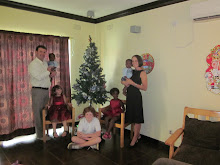
            I returned to Lilongwe determined to bring the Christmas spirit into the Fitzgerald home.  Saturday we loaded all five kids into the car and ventured out to buy Christmas decorations and suffer together through the special hell that is Shopping Day in Lilongwe.  It was actually the first time we had taken all five of them anywhere except “Two-for-Tuesdays” at Pizza Inn each week.  It went well, despite the not-unexpected need to go to 5 different grocery stores in order to purchase the simple items necessary to sustain our massive household for a few days.  The tree we bought for $70 US at the only “department store” was plastic, but the picture on the box was decent, and I grew excited.  Mostly we had a large selection of brightly colored cheap plastic Chinese Christmas decorations to choose from, but we found garland and tinsel, and even a few small ornaments.
            I worked most of the day on dinner, making seitan from scratch for a hearty stew.  As I was finishing cooking, I asked Dave to start to put the tree together, as I assumed it would take some time to assemble.  Literally 30 seconds later he said, “There. Done”.   I laughed, but he was serious.  The tree is a four-foot high replica of the Charlie Brown Christmas tree, and not just because Dave had forgotten to unwrap and open all of the branches.  It didn’t help when we did.  Last year we filled our living room with a 10 foot high North Carolina fir tree, decorated with the scores of ornaments I have acquired throughout my lifetime.  Looking at this tree, I almost cried.
            That night we put the a/c on really high, to make it feel cold, put some barely-audible Christmas tunes on the iPad, drank some hot chocolate, ate warm homemade snickerdoodles, and decorated the tree.  The children honestly didn’t seem to notice how pathetic it was.  They carefully hung makeshift ornaments from paper gift tags and enthusiastically hurled tinsel at the branches, all the while exclaiming about how beautiful our Christmas tree was.  We bought some spray-on snow and wrote “Merry Christmas” on our glass door, and covered it with pictures of snowmen and presents. Then we sang some of the more boisterous Christmas carols at the tops of our voices.  After the shiny silver garlands and smiling plastic (albeit slightly scary) Santa head were hung on the walls, it actually looked festive.
            Of course our kitten Nahla, considering the tree a worthy adversary given its size, lodged relentless assaults on it throughout the night and into the next morning, scoring significant damages.  We eventually lifted the (unimaginably) more pathetic remains of our Malawian Christmas tree onto a desk and out of reach, and that is where it stands today.  The giant Santa-head on our front door fell off almost immediately (which was OK), but at least some of the garland remains on the walls, despite the countless gun battles that take place in our living room each day.  All in all, the living room reflects my current mood: a little disheveled, relentlessly besieged by children, but determined to be festive.